Tesla’s Elon Musk Unveils Flying Sports Car With Gravity-Defying Tricks
By Dan Mughogho | Published October 17, 2026
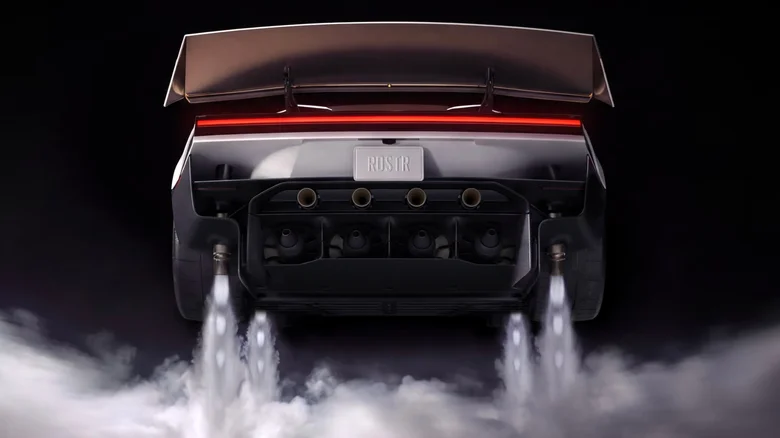
Tesla CEO Elon Musk has unveiled a futuristic demonstration of the second-generation Tesla Roadster, showcasing a series of gravity-defying manoeuvres that push the boundaries of conventional automotive design. During a presentation livestreamed on October 16, 2026, the electric sports car appeared to climb a ramp, turn upside down, hover and perform an aerial kickflip.
The demonstration attracted attention across the automotive industry because of the vehicle’s unusual movements and the technology reportedly responsible for them. Tesla presented the Roadster as a high-performance vehicle with capabilities extending beyond those of traditional sports cars.
Musk arranged for a live audience to witness the demonstration, addressing questions about whether the spectacular manoeuvres were generated using artificial intelligence or computer-generated effects.
The presentation featured the Roadster moving over a lineup of Tesla vehicles, including the Model series, Cybercab, Cybertruck and Tesla Semi. The vehicle then performed a horizontal kickflip during its airborne sequence.
Tesla also claimed that the Roadster could accelerate from zero to 60 miles per hour in just 0.81 seconds, with Musk suggesting that future performance could be limited primarily by driver safety.
While the demonstration showcased an ambitious vision for electric vehicles, questions remain about how the displayed capabilities would translate into practical road use, safety requirements and commercial production.
Tesla Roadster Demonstrates Flying and Aerial Manoeuvres
The second-generation Tesla Roadster was the centrepiece of the October 16 presentation, which featured a series of manoeuvres designed to demonstrate its unconventional capabilities.
During the livestream, the vehicle approached a curved ramp, climbed it and moved into an upside-down position. It then appeared to remain attached to the surface before launching into the air and performing a horizontal kickflip.
The car subsequently travelled over Tesla’s lineup of vehicles, creating one of the most visually striking moments of the presentation.
The demonstration suggested that Tesla was exploring vehicle control and movement beyond conventional acceleration, braking and cornering.
However, the ability to perform such manoeuvres does not automatically establish that the vehicle is suitable for ordinary roads. A production vehicle would need to meet applicable safety, reliability and regulatory requirements.
The Roadster demonstration therefore raises two separate questions: how the technology works and whether it can be developed into a practical, commercially available sports car.
Further technical details and independent verification would help establish the extent of the vehicle’s demonstrated capabilities.
How Does the Tesla Roadster Wall Trick Work?
The apparent wall-climbing and upside-down manoeuvres were among the most unusual features of the demonstration.
According to the supplied report, the Roadster uses a combination of wings, vents and fans positioned around and within its body to control airflow. These components are described as helping the vehicle stabilise itself and reorient during the aerial sequence.
The system reportedly includes a mechanism designed to create suction against the ramp’s surface. This ground-sealing arrangement would help the vehicle maintain contact with the surface while climbing or remaining inverted.
By generating sufficient pressure differences and controlling airflow, such a system could theoretically help counteract gravity under the right conditions. However, the exact engineering specifications, performance limits and independent test results would be needed to verify the mechanism described in the demonstration.
The vehicle’s apparent ability to remain upside down is therefore a major point of interest for automotive engineers and enthusiasts.
Unlike a conventional sports car, which relies on tyres, suspension and aerodynamic downforce to maintain stability, the demonstrated concept appears to depend on additional systems for surface attachment and movement.
The practical effectiveness of these technologies will depend on factors such as vehicle weight, surface conditions, airflow, power consumption and control-system reliability.
Tesla Roadster Uses Fans, Vents and Wings for Flight-Like Movement
The reported configuration of the Roadster includes several components intended to control airflow and help the vehicle move through its demonstration sequence.
These include:
- Fans: Reportedly contribute to the vehicle’s suction and airflow-management systems.
- Vents: Help direct air around the vehicle and support the manoeuvres described in the presentation.
- Wings: May contribute to aerodynamic control and vehicle orientation.
- Ground-sealing system: Is described as helping the vehicle remain attached to the ramp during inverted movement.
- Control systems: Would need to coordinate the vehicle’s movement, stability and transitions between manoeuvres.
Together, these elements suggest a concept that combines conventional automotive engineering with specialised systems for unusual movements.
However, the presence of fans, vents and wings alone does not establish that a vehicle can sustain powered flight. Verification would require detailed technical documentation and independent testing of the Roadster’s claimed performance.
The demonstration has nevertheless drawn attention to the possibility of developing new vehicle-control technologies that could influence future automotive design.
Tesla Roadster Claims 0–60 mph Acceleration in 0.81 Seconds
Tesla’s claimed acceleration figure was another major talking point during the presentation.
The company stated that the Roadster could accelerate from zero to 60 miles per hour in just 0.81 seconds. Musk suggested that the vehicle could eventually become even faster, although he acknowledged that driver safety would be an important limiting factor.
For context, 60 mph is approximately 96.6 kilometres per hour. Reaching that speed in less than one second would represent an extraordinary acceleration claim for a passenger vehicle.
The reported performance was associated with a limited-release “Thrust” augment. The presentation also referenced an invite-only “Rocket” augment, described as a flight-ready system intended to support forward and upward acceleration.
These claims require careful distinction between advertised specifications, demonstration capabilities and independently verified production performance.
Acceleration depends on several factors, including available power, traction, vehicle mass, tyre characteristics and the forces experienced by occupants.
At extremely high acceleration levels, driver and passenger safety becomes a substantial engineering concern. Tesla would need to demonstrate how the vehicle manages these forces while meeting applicable safety requirements.
Independent testing and final production specifications would help determine whether the claimed acceleration can be achieved under repeatable, real-world conditions.
What Are Tesla’s Thrust and Rocket Augments?
The presentation described two specialised systems associated with the Roadster’s performance.
The “Thrust” augment was linked to the vehicle’s exceptionally rapid acceleration, while the “Rocket” augment was described as an invite-only system designed for flight-ready movement and forward or upward acceleration.
These features were presented as part of Tesla’s effort to distinguish the Roadster from conventional electric sports cars.
However, the exact hardware, operating principles, limitations and availability of these systems require further clarification.
The terminology used during a presentation does not, by itself, establish whether a feature is ready for production or whether it will be included in every version of the vehicle.
Potential buyers will need confirmed specifications covering performance, safety, availability, pricing and operating requirements before they can assess the Roadster as a practical purchase.
For now, the claimed capabilities are best understood as part of the vehicle’s announced performance concept rather than as independently verified production specifications.
Elon Musk Uses a Live Audience to Showcase the Roadster
Musk’s presentation included a live audience, with the aim of allowing viewers to witness the demonstration rather than relying exclusively on edited footage.
The decision was notable because the Roadster’s aerial manoeuvres were so unusual that some viewers might otherwise question whether the footage had been generated or enhanced using artificial intelligence.
The livestream showed the vehicle climbing the ramp, turning upside down and performing its airborne sequence.
The event also generated reactions from automotive enthusiasts on social media. Some viewers praised the futuristic design and the potential for new automotive innovations, while others compared the spectacle to scenes from science-fiction films and video games.
A live demonstration can provide useful evidence that a manoeuvre occurred in front of an audience. However, it does not replace independent engineering tests or establish that all advertised capabilities are suitable for routine use.
Further technical disclosures and repeatable testing would be important in evaluating the Roadster’s claimed performance.
How the Tesla Roadster Could Influence the Future of Electric Vehicles
The Roadster demonstration has renewed discussion about how electric vehicles could evolve beyond conventional passenger-car designs.
Electric powertrains already provide manufacturers with opportunities to develop rapid acceleration, precise motor control and new vehicle architectures. Additional advances in aerodynamics, sensors and electronic control systems could expand those possibilities.
If the technologies described during the presentation can be developed safely and reliably, they could encourage further experimentation in specialised vehicle design.
Nevertheless, a car capable of performing dramatic stunts is not necessarily more practical than a conventional electric vehicle. Everyday transportation requires predictable handling, energy efficiency, passenger protection, reliability and compliance with road regulations.
The Roadster’s long-term significance will therefore depend on whether its unusual features can move beyond demonstrations and become viable engineering solutions.
The presentation may inspire manufacturers and engineers to explore new approaches, but the commercial impact will depend on the technology’s real-world performance.
For further coverage of innovative technology and major global developments, readers can explore Newsaih’s report on China’s selection of Nigerian-descended teenager Huang Shenghao for its senior national team.
Will the Tesla Flying Sports Car Be Available to Buy?
The demonstration presented the second-generation Tesla Roadster as an ambitious sports-car concept with performance features beyond those of conventional vehicles.
However, the information provided in the October 17 report does not establish a confirmed commercial delivery date, final production specifications or the price of a version equipped with the demonstrated systems.
Potential buyers should distinguish between a vehicle’s announced capabilities and features that have been confirmed for production.
Before purchasing decisions can be made, Tesla would need to clarify the vehicle’s final configuration, availability, performance limits, safety systems and regulatory status.
The flying and inverted manoeuvres would also require further assessment to establish whether they are intended for controlled demonstrations or could be offered as usable production features.
Until these details are confirmed, the Roadster’s unusual capabilities should be treated as claims associated with the unveiling rather than as proof that a fully road-legal flying sports car is commercially available.
What Happens Next for Tesla’s Second-Generation Roadster?
The Roadster presentation has placed renewed attention on Tesla’s performance ambitions and its approach to electric vehicle engineering.
The next important developments will concern the verification of its technical claims and the transition from demonstration to production.
Key areas to watch include:
- Independent performance testing: Whether the claimed acceleration and aerial manoeuvres can be reproduced under controlled conditions.
- Engineering details: Further information about the fans, vents, wings and systems reportedly used during the demonstration.
- Safety requirements: How Tesla would protect occupants during extreme acceleration and unusual vehicle movements.
- Production specifications: Confirmation of the final vehicle configuration and which features will be available to buyers.
- Commercial availability: Official details about pricing, delivery schedules and market availability.
These developments will help determine whether the Roadster represents a practical advance in automotive engineering or primarily a demonstration of an experimental concept.
Newsaih will continue to follow verified updates concerning Tesla, Elon Musk and developments in electric vehicle technology.
For more international coverage, readers can also visit Newsaih’s report on the proposed G7 diesel reserves initiative.
Frequently Asked Questions
What did Elon Musk unveil on October 16, 2026?
Elon Musk unveiled a demonstration of the second-generation Tesla Roadster featuring a ramp climb, an upside-down manoeuvre, apparent flight and an aerial kickflip.
Can the Tesla Roadster really fly?
The supplied report describes a demonstration in which the Roadster appeared to become airborne and perform aerial manoeuvres. The exact engineering capabilities and whether the vehicle can sustain powered flight require further technical verification.
How does the Tesla Roadster perform its wall trick?
The report attributes the manoeuvre to a combination of fans, vents, wings and a ground-sealing system designed to help the vehicle maintain contact with a ramp and control its movement. Detailed technical specifications would be needed to independently verify the mechanism.
How fast can the Tesla Roadster accelerate?
Tesla reportedly claimed a zero-to-60-mph time of 0.81 seconds. This figure should be treated as an announced performance claim until it is independently verified under clearly defined testing conditions.
What is the Tesla Roadster Thrust augment?
The “Thrust” augment was described in the presentation as a system associated with the Roadster’s exceptionally rapid acceleration.
What is the Tesla Roadster Rocket augment?
The “Rocket” augment was described as an invite-only system intended to support flight-ready movement and forward or upward acceleration. Its exact specifications and availability require further confirmation.
Why did Elon Musk use a live audience for the demonstration?
The live audience was intended to help viewers understand that the demonstration was taking place in front of witnesses and to address questions about whether the footage was AI-generated.
Is the second-generation Tesla Roadster available to buy?
The supplied report does not establish a confirmed delivery date, final production specifications or pricing for a version equipped with the demonstrated capabilities. Official production details are needed to confirm availability.
Is the Tesla flying sports car safe for everyday driving?
The demonstration alone does not establish its suitability for everyday roads. Safety, occupant protection, reliability and regulatory compliance would need to be assessed for any production version.
Could Tesla’s Roadster change the electric vehicle industry?
The demonstration could encourage further innovation in vehicle control, aerodynamics and electric performance. Its lasting impact will depend on whether the technologies can be verified, manufactured reliably and used safely.
Conclusion
Elon Musk’s unveiling of the second-generation Tesla Roadster on October 16, 2026, has attracted attention with a demonstration featuring ramp climbing, inverted movement, apparent flight and an aerial kickflip.
The presentation also included Tesla’s reported claim that the vehicle could accelerate from zero to 60 mph in 0.81 seconds, alongside references to specialised Thrust and Rocket systems.
The reported combination of fans, vents, wings and a ground-sealing mechanism raises interesting questions about the engineering behind the demonstration. However, independent testing and further technical details are needed to verify the full extent of the vehicle’s capabilities.
The Roadster’s significance will ultimately depend on its production specifications, safety, commercial availability and ability to translate its demonstrated features into reliable real-world performance.
Newsaih will continue reporting verified developments concerning Tesla, Elon Musk and the future of electric vehicles.
For more breaking news and international developments, visit Newsaih.
Contact Newsaih: info@newsaih.com
Editorial note: This article is based on the supplied report dated October 17, 2026. Acceleration figures, flight-related features and technical explanations are presented as reported claims and have not been independently verified in this article.