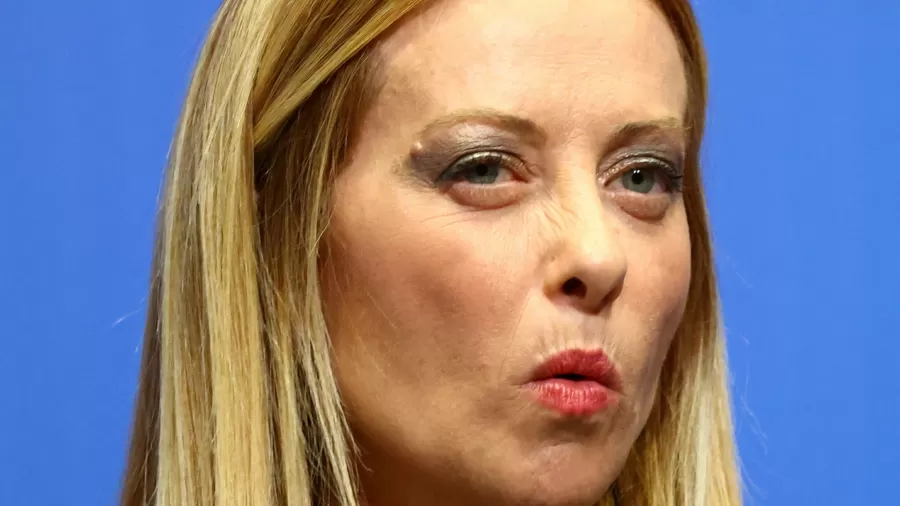
Italian Prime Minister Giorgia Meloni said on Sunday (September 20) that she will soon present her cabinet with a measure to ban the wearing of burkas and niqabs in schools, as well as limit the number of foreign students in classrooms.
The measure was announced at the national festival Gioventù Nazionale (“National Youth”), an event of the youth wing of Meloni’s ultranationalist conservative party, Brothers of Italy (FdI).
She specifically referred to the ban on the burqa – a garment that covers the entire body, worn by some Muslim women – and the niqab – a veil that leaves, at most, only the eyes visible.
Meloni, however, did not mention the hijab, the headscarf worn by many Muslim women.
The restriction on the use of burkas in schools had already been advocated in July by the far-right National Future (FN) party.
This party – which is not part of the governing coalition and is positioned even further to the right than Meloni’s party – emerged as a strong competitor to the FdI, registering a rapid rise in the polls since its launch in February.
Although there is no law in Italy that expressly prohibits the wearing of burkas, either in schools or in public places, a 1975 law forbids the wearing of helmets or clothing that makes identification difficult, unless there is a valid justification.
In 2008, Italy’s highest administrative court clarified that veils covering the entire face can be worn for religious or cultural reasons, provided the face is revealed when identity verification is required.
The ultraconservative and anti-immigration League party, a member of Meloni’s coalition, introduced a bill in the Senate earlier this year to ban helmets or clothing that conceals the face, except in specific circumstances such as sporting events or places of worship.
Limit on foreign students in schools “A measure will soon be presented to the Council of Ministers to legally establish a maximum number of foreign students per class,” said Meloni, to a standing ovation from the participants at the meeting in Rome.
According to him, the proposal would also make Italian language classes mandatory for parents of foreign students who have “serious difficulties integrating into the school system.” “For us, anyone who comes to Italy and wants to build their future here must learn our language, understand our culture, and respect our rules,” the prime minister said.
“It’s the only serious way to welcome them.” Italian law already sets a limit on the number of foreign students per class.
Since 2010, a maximum of 30% of a class and the student body of a school can be made up of foreigners.
Meloni, however, did not say how this rule would be changed. This limit may be raised in cases involving foreign students with adequate language proficiency – such as those born in Italy – or reduced when foreign students demonstrate low proficiency in the Italian language.
According to the National Institute of Statistics (ISTAT), foreign students represent just under 12% of the total number of students enrolled in Italian schools.
If approved by the Prime Minister’s cabinet, the measures would still need approval from the Italian Parliament within 60 days before becoming law.