
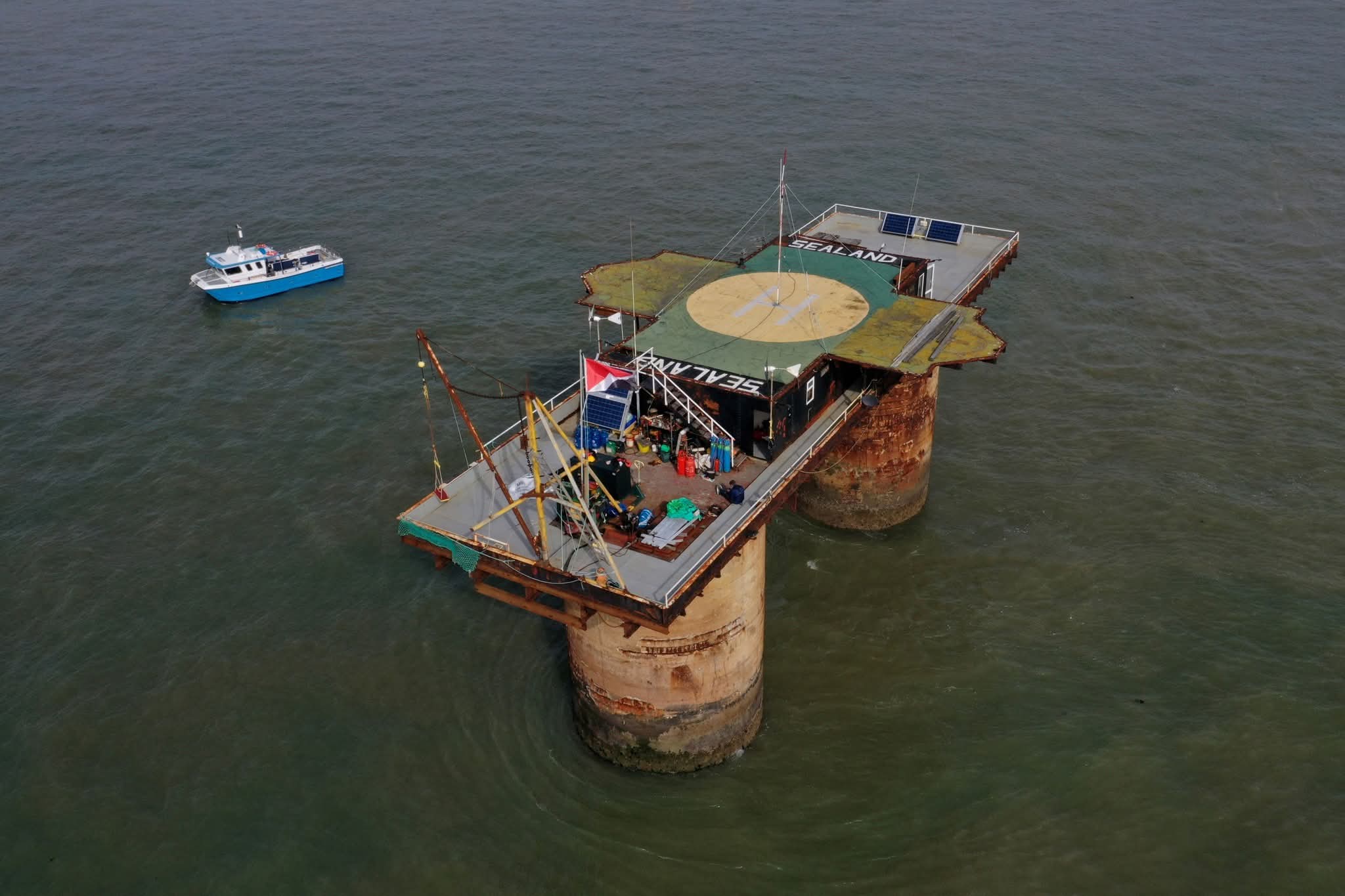
Hidden in the North Sea, just off England’s coast, is a self-declared country built on a World War II sea fort ( Sealand). It has a prince, a flag, its own money and a history packed with invasions, gunfire, and global attention.
You might think nothing in this world can surprise you anymore until you learn that the smallest “country” on Earth isn’t Vatican City.
It’s a lonely steel platform rising from the sea, ruled by its own royal family and known as the Principality of Sealand.
Sealand sits about seven miles off the coast of Essex in the English Channel. Reaching it isn’t easy. Visitors must brave a rough 20-minute helicopter ride or an equally challenging boat trip across open waters.
What waits at the end looks like something out of a movie: a giant concrete-and-steel structure standing 60 feet above the sea on hollow legs.
From wartime fortress to “independent nation”
Sealand began life in 1943 as Roughs Tower, a British sea fort built by the Royal Navy to defend shipping lanes from German aircraft during World War II.
Around 200 soldiers once manned the platform, reportedly shooting down dozens of enemy planes before it was abandoned after the war.
Everything changed in 1967 when Paddy Roy Bates, a former British Army major and pirate radio broadcaster, took over the structure.
He removed rival radio operators, moved his family in, and made a bold declaration: Roughs Tower was now an independent state. He renamed it the Principality of Sealand and crowned himself Prince Roy.
A country the world refuses to recognise — but can’t ignore
No nation officially recognises Sealand. Even so, Britain never formally claimed it when it lay outside territorial waters.
For years, Sealand existed in a legal grey zone, issuing passports, stamps, and coins linked to the US dollar. Anyone visiting was required to carry their own passport.
Although the UK later extended its territorial waters in 1987, Sealand continues to insist it remains proudly independent.
Armed invasions and a real-life coup
Sealand’s story took a dramatic turn in 1978 when armed mercenaries attempted to seize the platform while Prince Roy was abroad.
His son, Prince Michael of Sealand, led a daring counter-operation, retaking the fort by helicopter at dawn and disarming the attackers.
One invader, German lawyer Alexander Achenbach, was charged with treason under Sealand law and held prisoner.
Germany was eventually forced to send a diplomat to negotiate his release one of the moments Sealand supporters point to as proof of its “statehood.”
Life on the edge of the sea
Living on Sealand is not for everyone. Early life there had no electricity or gas, and conditions were harsh. Over time, Prince Roy and his wife Joan transformed the platform into a surprisingly homely space, complete with books, rugs, pot plants, and a working kitchen.
Supporters say there are no utility bills and total independence is part of the appeal. Critics call it madness. Either way, Sealand has never lacked character.
Sports, scandals, and survival
Despite lacking recognition, Sealand has flown its flag across the world. Athletes have competed in its name, a football team has played international fixtures, and in 2013 a Sealand flag even reached the summit of Mount Everest.
The 1990s brought controversy when criminal networks exploited Sealand passports for fraud and money laundering. Prince Roy responded by cancelling all issued passports, distancing the micronation from the scandal.
A legacy that lives on
Prince Roy died in 2012 at the age of 91. His wife Joan passed away in 2016. Today, Prince Michael carries on the legacy, with his children James, Liam, and Charlotte involved in shaping Sealand’s future. Remarkably, the platform even recorded zero COVID-19 cases during the pandemic.
Love it or laugh at it, Sealand remains one of the most unusual political experiments in modern history a tiny “country” in the middle of the sea that refuses to disappear.
Would you dare to visit Sealand? Share your thoughts in the comments below.