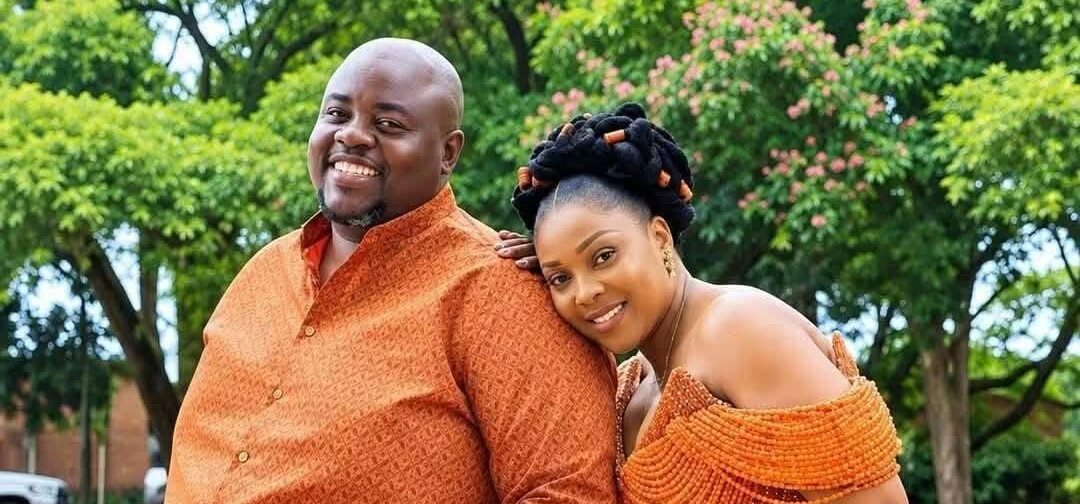
Today, tomorrow, Marondera: the last flight of Sir Wicknell
He wrote the name of the town on the tail of his jet. On Wednesday evening, Marondera wrote the end of his story.
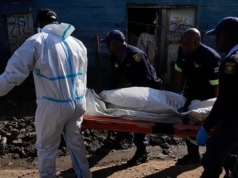
Wicknell Chivayo died when a helicopter he was flying in came down in the Marondera Rural area, about 70km east of Harare, at around 5pm. He had been an ex-convict who became Zimbabwe’s most flamboyant tenderpreneur, the President’s self-appointed shadow and the country’s most extravagant giver of gifts. He was 43. His wife, Lucy “Lulu” Muteke, died with him. Nobody on board survived.
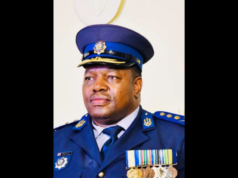
Government spokesperson Nick Mangwana on Wednesday said the aircraft had been carrying a high-profile businessman, three other passengers and two pilots. We have however, now confirmed that the Chivayos were accompanied by Mrs Chivayo’s aide and two pilots. Their security was on another aircraft. Police spokesperson Commissioner Paul Nyathi said the bodies were badly burned and awaited formal identification. The family did not wait. “We are at a loss for words after the tragic incident,” family spokesperson Herbert Chivayo told ZBC.
In Maseru, sources say, his death also closes a chapter that had barely begun: he had quietly visited Lesotho in recent months, reportedly eyeing investments in energy and fertiliser.
By nightfall, a source said, Zimbabwe’s intelligence departments were being called into situation rooms for urgent meetings. That alone said much about the man in the helicopter. A businessman had died in a field, and the security state had stirred.
The cause of the crash, the identities of the four other victims and the ownership of the helicopter had not been established at the time of publication. [We have now established that he was traveling with his wife, two pilots and the wife’s aide.]
Marondera had followed him for years.
On the tail fin of his private jet, T7-WMC, beneath a cross, a starburst and a pair of praying hands, ran the words: “Johane aka tumwa. Today, tomorrow, MARONDERA.” Johane was sent. On the winglet were his initials and three sevens: WMC 777. In May, explaining his faith to a follower, he used the same phrase, vowing to spend all the days of his life praying, going “TODAY TOMORROW MARONDERA”.
Marondera was where his in-laws farmed. It was there, ten days after he paid lobola for Ms Muteke in March 2025, that some 20 armed men came in the dark for the bride price. And it was there, on a Wednesday evening, that his helicopter fell out of the sky.
What the town truly meant to him, he never explained. He has taken the answer with him.
To the end, he was giving things away in public.
His last Facebook post, tagged at Chishawasha Hills in Harare, opened in his trademark capitals: “APPRECIATING RELATIONSHIPS BUILT OVER DECADES… SAVED THE BEST FOR LAST.” In Shona, he declared that all he knew was that he had never been defeated, and he described himself as working through an “ENDLESS QUEUE of appreciation”.
The last man in the queue was Harare lawyer Wilson Tatenda Manase. His firm had instructed the advocates who defended Mr Chivayo over the years, among them Lewis Uriri SC. Mr Chivayo said he had known Mr Manase since 1998, “when I was still renting ONE ROOM in Hillside”. He called him a “FATHER FIGURE, MENTOR, BROTHER, ADVISER”. The gift, he wrote, “REMAINS THE SAME”. Mr Manase should go and see “VICTOR on MONDAY next week”.
Monday will come. Sir Wicknell will not. Saved the best for last now reads like an epitaph he wrote for himself.
Few Africans have lived so loudly, or so publicly.
He did not own a car; he owned a fleet, led by Rolls-Royces in black and white. He did not fly; he had private jets, their tails painted with scripture. He did not wear a watch; he wore a statement, and then told you its price.
On July 11 he was at the Jacob & Co. factory in Geneva, seated beside its owner, Jacob Arabo, over a tray of timepieces. “TIME IS MONEY,” he wrote. He had been invited by the owner, he explained, and had decided to spoil himself with “a few classic watches worth USD 4.3 million”. Then, lest anyone forget his benefactor: “GOD IS THE GREATEST.” On September 3 he was back in Geneva, this time thanking Mr Arabo for a gift, the latest Godfather 2, which he valued at $660,000.
He showed off a Cape Town mansion reportedly worth R160 million. His lobola ceremony was a pageant of designer shoes stacked in rooms, glittering watches and convoys of luxury cars. His new bride soon had a Range Rover and a Land Cruiser in the driveway. When he handed out cash, the photographs showed it in bricks, stacked on the bonnets of new cars beside bunches of balloons.
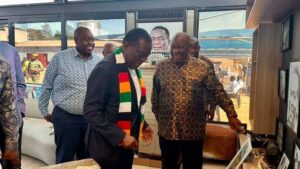
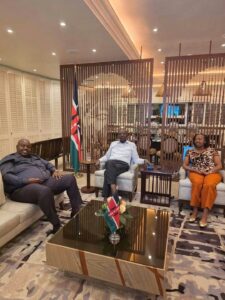
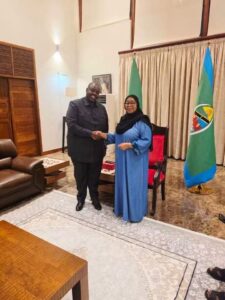
He moved through the continent’s palaces as if they were his living room. He posed with Uganda’s Yoweri Museveni. On July 22 he was at State House in Nairobi, pumping the hand of President William Ruto. “JAMBO NAIROBI,” he wrote, before asking his followers to please ignore the $1.7 million diamond-set Jacob & Co. piece on his wrist. Then came “KARIBU TANZANIA”, with pictures beside President Samia Suluhu Hassan beneath her own portrait.
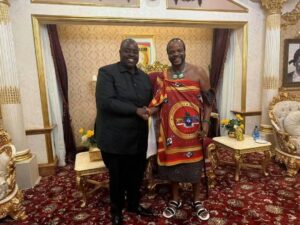
In August it was eSwatini. He dined with King Mswati III at the Royal Palace and gushed about the monarch’s “remarkable HUMILITY”. He said His Majesty was encouraging his “RENEWABLE ENERGY PROJECTS” in the kingdom, the same language once used to sell Zimbabweans a solar plant in Gwanda. “ESWATINI IS NOW MY THIRD HOME,” he wrote, with three laughing emojis. He said he had bought a mansion there worth R500 million. Days later he strode across the kingdom’s airport tarmac wrapped in red Swazi emahiya, past parked private jets. The caption was three words and three praying hands: “TIRI MADZIMAMBO.” We are kings.
Lesotho was reportedly next. Sources say he flew quietly into the Mountain Kingdom a few months ago, without the fanfare that usually followed him, and was expected back within months. His interests were allegedly in energy and fertiliser. The first was the business that made his name and his notoriety, from Gwanda to the “renewable energy projects” he was promising eSwatini.
The second would have been new territory for a man better known for harvesting tenders than crops. Unusually for someone who photographed almost everything, there were no palace pictures and no capital-letter captions. Whatever he had planned for Maseru, he took it with him.
Even the children were catered for. On September 22, four days after Apple’s iPhone 18 Pro Max went on sale at a starting price of $1,299, he announced new handsets for his children and 13 of their friends. The 15 phones cost at least $19,500 before import duties, more than many Zimbabwean teachers earn in a decade.
Two days before he died, he posted from the Johane Masowe Chishanu church under a caption that summed up his last season: “THE BIGGER PREACHER.” One photograph showed him behind a desk piled with files. Another showed him stepping out of a Rolls-Royce on a European street. In the third he stood in flowing white robes beside a black Rolls-Royce, hands folded, the preacher’s pose and the billionaire’s car in one frame.
None of it began in a boardroom. It began in a cell.
In 2004 he was jailed for three years for theft by false pretences involving R837,000, and he served his sentence at Chikurubi Maximum Security Prison. In 2009 he was charged over an alleged R2 million con and spent weeks in Bulawayo Prison before a magistrate acquitted him.
Within a decade the ex-convict was fronting Intratrek Zimbabwe, which between 2015 and 2016 was awarded energy contracts worth more than $600 million.
The most notorious was a 100-megawatt solar plant in Gwanda. The Zimbabwe Power Company paid Intratrek about $5.6 million in advance, without a bank guarantee. In 2018 a parliamentary committee chaired by Temba Mliswa, a relative of President Mnangagwa, went to see what the money had built. It found two temporary shacks.
The committee recommended that the contract be cancelled and the money recovered. It also said his criminal record disqualified him from running a Zimbabwean company. He was arrested but never convicted. Gwanda never produced a single megawatt. Its promoter went on to produce headlines for the rest of his life.
His politics followed the weather.
In the Mugabe years, critics say, he mocked the camp gathering around Emmerson Mnangagwa. When the tanks rolled in November 2017, he changed sides with the speed of a man who knew where the next tender would come from. By July 2018 he was tweeting “EDHASMYVOTE”. That was the same year the President had publicly hinted that he could face prosecution over Gwanda.
What followed was one of the most remarkable rehabilitations in Southern African politics. The man named in a parliamentary report became a fixture at the President’s side, by turns aide, bag carrier and self-appointed bodyguard. He was photographed resting his head on the President’s chest, an image that said more about the Second Republic than any policy document. Critics alleged, though it was never proven, that he charged premiums to arrange access to the President.
Once inside the tent, he turned his guns outward. He became one of the loudest online attackers of the President’s rivals, above all Vice-President Constantino Chiwenga. Mr Chiwenga’s camp railed against the “zvigananda”, the politically connected tenderpreneurs it accused of capturing the state. Few people fitted the description as neatly as the man mocking it.
On September 15 he hailed President Mnangagwa as “my beloved FATHER” on his 84th birthday. He pledged $50,000 each to the families of 40 fallen national heroes, among them those of Joshua Nkomo, Simon Muzenda and Air Chief Marshal Perence Shiri, “my beloved HOME BOY”. It was a $2 million birthday card, posted beside photographs of him leaning into the President’s shoulder, beaming.
Proximity had its price, and two former friends paid it.
Mike Chimombe and Moses Mpofu said he had promised to secure Zimbabwe Electoral Commission business for them before the 2023 elections, without a public tender.
The deal ran through Better Brands, the company of gold dealer and Zanu PF MP Scott Sakupwanya, and South African supplier Ren-Form. Leaked documents pointed to contracts of up to $40 million.
The partners accused him of cutting them out and taking 66 percent. They demanded $10 million.
Then the audio leaked. A voice said to be his boasted of deals with the police and immigration and declared, “I am inside the President’s circle.” Zanu PF warned him to stop using the President’s name.
He disowned the recording, dismissed the pair as “failed, struggling briefcase businessmen” and extortionists, and apologised to the President and the First Lady.
The electoral commission and Ren-Form denied any dealings with the trio.
The Zimbabwe Anti-Corruption Commission summoned all three. Only two ended up in the dock, and not over ballots. In December 2025 Mr Chimombe and Mr Mpofu were convicted of defrauding the state of $7.3 million under the Presidential Goat Pass-On Scheme, and jailed for effective terms of 12 and 15 years.
He was never charged. His former friends went to Chikurubi, the prison where his own story had begun. He went on handing out Rolls-Royces.
As the fleet grew, so did the titles. First came “Sir Wicknell”. Then came “the Bigger Preacher” and finally, “Mukuru wemazuva”, Ancient of Days, the name the Book of Daniel gives to God himself.
Those who received his gifts used those names to appease him. Sungura king Alick Macheso received a Toyota Fortuner and $10,000, and his manager a Toyota Aqua and $2,000, in a video shared crediting “Mukuru wemazuva Sir Wicknell”. A prophetess, thanking him in July for a birthday gift, addressed him the same way.
Christians cried blasphemy. On May 24 he answered them on Facebook in a long letter, in English and Shona, to a follower named Simbarashe. The name was not self-imposed, he wrote. The believers at Masowe had given it to him, just as the church’s founder, Johane Masowe, had been called Mukuru wemazuva for the miracles of his time. “The glory is not mine,” he wrote. “It belongs to the Father in heaven.”
Then, in the same breath, he counted his blessings on others. He said he had given Fortuners and $10,000 each to 10 men who happened to be standing near him at a Friday service, and Aquas and $2,000 each to 20 women he did not know.
One Christmas had cost him $490,000. He had given the church leader’s wife $1 million for her birthday, and the leader no longer had parking space at home. He had bought 40 buses at $240,000 each and would make it 100 by year end. The buses, he stressed, carried the founder’s face, not his. Anyone who greeted him as “Baba Johane” was guaranteed $100 for lunch.
He signed off: “Yours Sincerely, MUKURU WE MAZUVA.”
Churches outside Masowe did well too. On September 6 he gave a Rolls-Royce Ghost and $250,000 in “lunch money” to the household of Uebert Angel, the presidential envoy filmed in Al Jazeera’s Gold Mafia series boasting he could move $1.2 billion. Ten days later he posted from the Zion Christian Church to honour its leader, “HIS GRACE” Bishop Nehemiah Mutendi. The bishop’s “BRAND-SPANKING-NEW ROLLS-ROYCE CULLINAN FACELIFT” had arrived, gleaming white under showroom lights. It would be handed over by “THE PRINCIPAL”, with $250,000 “petty CASH FOR FUEL AND PERSONAL USE”.
Servants of God, he wrote that day, must be honoured “WHILE THEY ARE STILL WITH US”. Nobody should wait until someone is gone before speaking of what they gave.
Gold was never far from his story. He was not among those filmed in the Gold Mafia series, but critics long alleged he moved gold for dealers and politicians, claims that were never tested. This year South Africa’s Hawks pursued Joachim Chivayo, whom Wicknell called his “little brother”, over an R15 million gold case, though no formal link to Wicknell was made.
There were also allegations of tax evasion in fuel and gas imports, and a cancer-equipment contract worth nearly half a billion dollars that critics said bypassed procurement rules. He denied every accusation. None of them reached a courtroom.
His private life was as loud as his public one, and less happy.
His marriage to socialite Sonja Madzikanda ended in a bitter divorce in 2024. Then came Lulu, reserved and camera-shy, the quiet half of the loudest couple in Harare. Her lobola was widely reported at $300,000. He said it was nearer $20,000, but admitted sending her family $75,000 to prepare for the ceremony.
Ten days later, armed men arrived at the Muteke family’s Alpha and Omega Farm in Marondera. They beat the guards, cut through the burglar bars and made off with $74,100 in cash, a pistol and phones. The courts showed no mercy. In August, 18 robbers were sentenced to a combined 1,179 years, with effective terms of 76 and 55 years each. To many Zimbabweans, used to seeing ordinary victims wait years for justice, the severity looked like the long reach of a famous son-in-law and his friend in State House.
This year the photographs that built his legend began to turn on him. After South African President Cyril Ramaphosa’s visit to Zimbabwe in May, images surfaced that seemed to show the two men together before the trip. Pretoria called him a “person of interest” to its law enforcement agencies.
He had his ex-wife and her mother, Tabitha Madzikanda, arrested. He accused them of using artificial intelligence to fake the images and of targeting a $1.4 million trust set up for his children. Days later he dropped the charges, saying he had forgiven them for the children’s sake. “I don’t regret anything,” he added. That same week, he was explaining to his followers why they called him the Ancient of Days.
As news of the crash spread on Wednesday night, an August 22 Facebook post by Dr Obey Tichafa Mukanhairi began to travel across Zimbabwe’s phones. Among his “Prophecies next level”, the fourth read: “I was in Zimbabwe I saw death of a very big man in politics, I saw a trailer carrying a casket, is it on a Wednesday morning few days after a public holiday.”
His followers say it has come to pass. They describe him as a man who is shown things before they happen, and by midnight his words had been shared far beyond Zimbabwe’s borders.
Zimbabwe has seen this story before.
Almost six years ago, in the early hours of November 8, 2020, Genius “Ginimbi” Kadungure left a birthday party at his own Dreams nightclub in Harare in his Rolls-Royce Wraith. On Borrowdale Road it smashed head-on into a Honda Fit, hit a tree and burst into flames. Mr Kadungure, 36, was flung from the wreck and died on the spot. His three passengers, among them influencer Michelle “Moana” Amuli, burned beyond recognition. Even the police spokesperson was the same: Commissioner Nyathi, then as now, told the nation that a high-flyer had fallen.
The parallels run deep. Both men rose from nothing to wealth few could explain, and both built their legends one Rolls-Royce at a time. Both turned social media into a shop window: champagne showers and Lamborghinis for one, watches, jets and Cullinans for the other. Both made their names in energy. Mr Kadungure founded Pioneer Gases; Mr Chivayo sold solar power that never came and faced untested allegations over fuel and gas imports. Both died violently, with others beside them, in the machines that symbolised their success.
The contrasts are just as sharp. Mr Kadungure was a party king who wanted to be seen. Mr Chivayo was a power broker who wanted to be seen next to the powerful. One died on a city road at dawn after a night of champagne; the other fell from the sky on a weekday evening, in a town he had painted on his jet. Mr Kadungure’s death set tongues wagging in nightclubs. Mr Chivayo’s, a source said, sent intelligence chiefs into situation rooms.
Then there is juju. After Mr Kadungure’s death, social media filled with claims that his fortune had been built on ritual pacts and that the crash was the price paid.
The claims spread so widely that his former partner publicly defended him against witchcraft accusations. Within hours of Wednesday’s crash, the same whispers were circulating about Mr Chivayo. Where had such wealth come from? Had it come at a cost? Such claims come with no evidence and can never be tested. But in a country where fortunes this large rarely have a visible source, the questions are as old as the money itself.
Mr Kadungure was buried at his Domboshava mansion in an imported Versace casket, as thousands gathered and expensive cars lined the village roads. How Mr Chivayo will be sent off, and by whom, may say as much about his place in Zimbabwe’s power structures as anything he did in life.
Mr Chivayo leaves two children and a fleet of cars scattered among pastors, musicians, lawyers and politicians. He leaves a collection of watches worth more than most Zimbabweans will earn in many lifetimes. And he leaves a question his country has never answered: how does a man jailed for fraud, and named over millions paid for a solar plant that never existed, end up with his head on the President’s chest while his former partners serve their time?
Supporters will remember the gifts, the buses and the heroes’ families. Critics will remember Gwanda, the election audios and an Ancient of Days who never answered for any of it.
He was the Second Republic’s political economy in human form, and its loudest advertisement. He said out loud, and posted in capitals, what the system preferred to whisper.
He spent his life flying above the questions.
On Wednesday evening he came down with all of them unanswered, in the one place he had painted on his aircraft: today, tomorrow, Marondera.