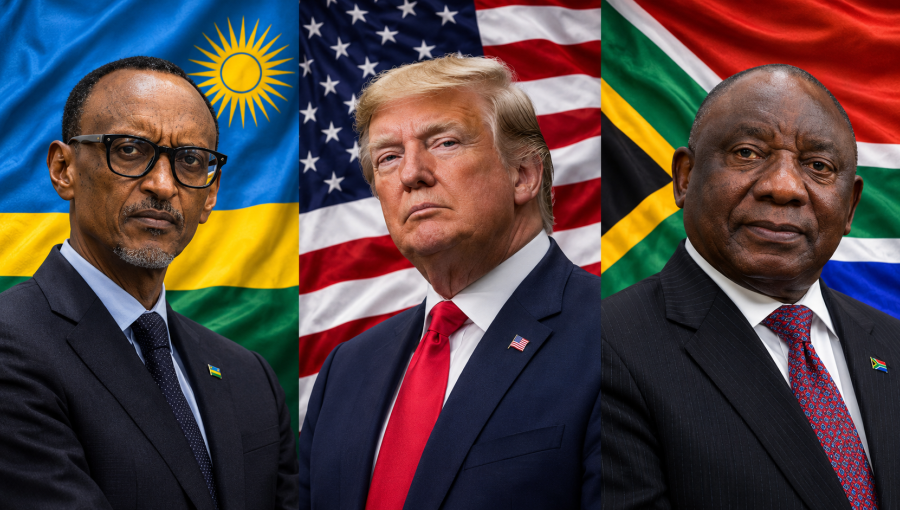
On Monday, US Trade Representative Jamieson Greer announced Washington intends to suspend South Africa and Rwanda from duty-free access under the African Growth and Opportunity Act, effective January 1, 2027.
President Donald Trump found that the governments of Rwanda and South Africa are engaging in practices that are “inconsistent with AGOA’s eligibility criteria,” Greer said, citing trade barriers and human rights concerns.
South Africa exported about $1.7 billion in goods under the program in 2025, though these exports represent only about 10% of its total US trade and 1% of its global exports.
Prepared for a negative outcome, South Africa’s trade ministry remains open to dialogue while President Cyril Ramaphosa pursues new trade deals with partners such as China.
Administration officials flagged South Africa’s International Court of Justice case against Israel as a foreign policy concern, while the government characterizes claims of white persecution as “a falsehood spread by fringe groups.
The United States plans to remove South Africa and Rwanda from the African Growth and Opportunity Act (AGOA) from January 1, 2027, ending preferential access to the American market for two African economies as Washington tightens eligibility under the trade programme.
US Trade Representative Jamieson Greer announced on November 2 that President Donald Trump intended to terminate both countries’ AGOA eligibility after finding, following an annual interagency review led by USTR, that their governments were engaging in practices inconsistent with the programme’s criteria. Trump notified Congress and the two governments of the decision, Reuters reported.
For South Africa, Washington cited barriers to US trade and investment, corruption and threats to US national security and foreign policy interests. For Rwanda, it cited trade and investment barriers, rule of law, political pluralism, worker rights, human rights and threats to US national security and foreign policy interests.
South Africa is AGOA’s largest beneficiary, with US duty-free imports under the programme worth $1.6bn in 2025, according to the Congressional Research Service. AGOA gives eligible African countries duty-free access for thousands of products, including agricultural goods, vehicles and manufactured products.
AGOA preferences do not override separate US tariffs on certain products. Duties on vehicles, steel and aluminium already apply, and South Africa’s earnings from vehicle exports to the US fell to ZAR8bn in 2025 from about ZAR17.7bn in 2024, Sowetan reported. Withdrawal from AGOA would remove preferential access rather than end trade with the United States. South Africa’s trade ministry said last week that AGOA exports accounted for about 10% of its exports to the US and 1% of its global exports, Reuters reported.
The US took 7.1% of South Africa’s merchandise exports in 2025, down from 7.7% in 2024, as Germany overtook it to become the country’s second-largest export destination after China, according to the South African Reserve Bank, IntelliNews reported. A February 2025 study by the Solidarity Research Institute estimated that exports to the US supported 576,164 South African jobs, about half of them in sectors that benefit from AGOA terms.
Trade, Industry and Competition Minister Parks Tau told the National Economic Development and Labour Council on October 29 that South Africa was “ready whatever the decision” and that its “doors remain open for dialogue”, SAnews reported. “Whatever the outcome, our economy will remain stable, our exporters will keep trading,” he said, adding that South Africa “will have 60 days to address them before any suspension” if US concerns remained. Tau put bilateral trade at $28.8bn in 2025 and said more than 600 American companies operating in South Africa support about 134,600 jobs, while US firms had made more than $5bn in investment commitments over the past year.
President Cyril Ramaphosa warned on October 19 that the country must prepare for possible exclusion, describing the potential impact on jobs as “devastating”. Pretoria has been pursuing alternative markets in Africa, Asia and Europe, and China introduced zero-tariff treatment for qualifying South African products from May 1, 2026 to April 30, 2028. Relations with Washington have deteriorated over disagreements involving South Africa’s domestic policies and its genocide case against Israel at the International Court of Justice. Pretoria rejects US allegations of persecution against white South Africans, while Israel denies genocide. At a Senate hearing in December 2025, Greer said South Africa was “a unique problem” and that he was open to treating it differently under AGOA, IntelliNews reported, citing IOL.
US Ambassador to South Africa Leo Brent Bozell III called the decision a “predictable and preventable outcome” of “the rejection by South Africa’s government of real concerns raised by the US government”, adding that “the South African government must understand the gravity of the situation”, in a post on X on November 2, SAPeople reported. He said he remained “hopeful that we can find a path forward to address our larger bilateral concerns”.
Labour federation Cosatu said it was “deeply concerned” and urged the government to “utilise the next 60 days before this exit comes into effect”, Sowetan reported. Trade union Solidarity blamed Pretoria. “The government, Lamola and Ramaphosa must take full responsibility for this exclusion,” said Jaco Kleynhans, its head of public relations, referring to International Relations Minister Ronald Lamola. “Ordinary workers and industries will now pay the price for political negligence,” he said, Food For Mzansi reported.
Agricultural exporters, among AGOA’s main South African users, warned of higher costs rather than lost access. Wandile Sihlobo, the presidential envoy on agriculture and land, estimated that losing AGOA preferences could add about 3.4 percentage points to tariffs on certain qualifying products now facing a 12.5% US duty, taking the rate to about 15.9%, below the 30% levied in 2025. The impact would vary by product. “We will have access, but with slightly higher tariffs,” he said, according to Food For Mzansi. Farm lobby AgriSA said the priority was retaining American customers and protecting rural jobs. “This will be a loss not just for us, but the US consumer will lose too,” said Boitshoko Ntshabele, chief executive of the Citrus Growers’ Association of Southern Africa, Sowetan reported.
Rwanda lost AGOA benefits for apparel exports in July 2018 following a dispute over its higher duties on imports of second-hand clothing from the US. The January termination would extend beyond that product-specific suspension, although Rwanda’s exposure is small: US goods imports from the country totalled $43.3mn in 2025, according to USTR. Neither government had issued an immediate response to Washington’s November 2 announcement, Reuters reported. Rwanda’s Foreign Minister Olivier Nduhungirehe told AFP last week, before the decision, that “Rwanda must not be held as a scapegoat for what is happening in Congo forever”, eNCA reported. Kigali denies US accusations that it backs the M23 rebel group in eastern Democratic Republic of Congo.
The decision follows a one-year renewal in February, which extended AGOA to December 31, 2026 retroactively after it lapsed on September 30, 2025, and Congress’s September extension of AGOA through December 2028. Country eligibility remains subject to annual US review, and the president must notify Congress at least 60 days before terminating a country’s benefits. The planned January exclusions would therefore affect South Africa and Rwanda individually rather than terminate the wider programme. Washington last removed beneficiaries in January 2024, when Gabon, Niger, the Central African Republic and Uganda lost eligibility.