
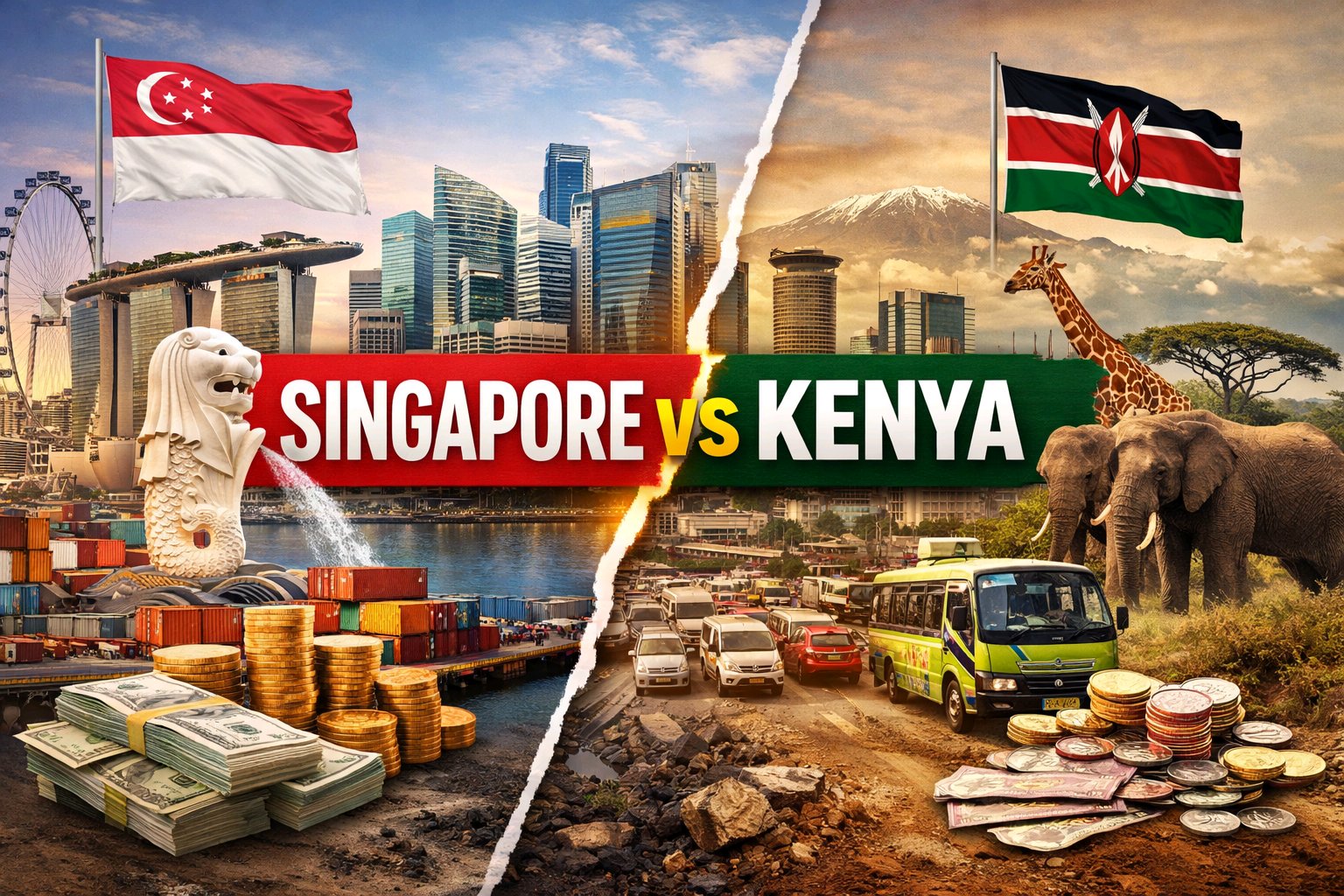
In 1963, Kenya and Singapore were essentially at the same starting line. Both were emerging from British rule with modest economies and big dreams. Today, Singapore’s GDP per capita has crossed $88,000, while Kenya struggles to stay above $2,200.
For years, we’ve comforted ourselves by saying Kenya is a “land of immense potential.” But as the 2025 economic data rolls in, it’s clear that potential is just a polite word for unfinished business. The difference isn’t intelligence or land; it’s the Cost of Friction.
1. “Traffic Tax”: Nairobi’s Productivity Killer
Time is the only resource we can’t get back. In Singapore, the average commute is under 45 minutes because they treated transport as an economic lever. In Nairobi, we treat it as a “matatu problem.”
- The Reality: Nairobi loses an estimated KSh 60 billion a year to traffic.
- The Impact: When you spend 3 hours a day stuck on Mombasa Road or Thika Road, you aren’t just losing fuel; you’re losing mental energy, family time, and billions in national output.
2. Informality Trap: 90% of Jobs are “Off-Grid”
According to the KNBS 2025 Economic Survey, 90% of all new jobs created in Kenya last year were in the informal sector.
- Kenya: We celebrate the “hustle,” but a hustle is hard to tax, hard to insure, and hard to scale.
- Singapore: Informality is non-existent. Because every business is formal, the government can plan, provide credit, and develop specific skills. In Kenya, we are building a “gig economy” without the safety nets to support it.
3. Corruption: The Hidden Receipt
Transparency International’s latest report ranks Singapore as one of the least corrupt nations (84/100). Kenya sits at 32/100.
- The Math: Corruption in Kenya isn’t just about big scandals; it’s the “kitu kidogo” that adds 10% to 20% to the cost of every road, every bridge, and every business license.
- The result? We pay “First World” prices for “Third World” infrastructure.
4. Housing: It’s Not Just a Roof
Over 80% of Singaporeans live in government-planned HDB estates. This provides a stable workforce. In Kenya, our housing deficit is over 2 million units, and most urban workers live in informal settlements that undermine their health and productivity.

The Lesson: Housing is a productivity tool. A rested, secure worker produces more.
2024-2025 Execution Scorecard
| Metric | Kenya (2025) | Singapore (2025) |

| GDP Per Capita | ~$2,200 | ~$88,500 |

| Corruption Score | 32/100 (Stagnant) | 84/100 (Clean) |

| Company Registration | Days/Weeks | Minutes/Hours |

| Average Commute | 90+ Minutes | Under 45 Minutes |
The Real Opportunity for Kenyans
Singapore didn’t wait for “perfect conditions.” They built institutions first, and the wealth followed. Kenya has enough “vision documents” to fill a library; what we lack is the discipline to stick to the plan past the next election cycle.
However, for the Kenyan entrepreneur, every broken system is a business opportunity.
- If the logistics are broken, start a delivery firm.
- If the banks won’t lend, build a fintech.
- If the power is unreliable, sell solar.
Kenya is an “unfinished” market. And for the patient and the disciplined, unfinished markets are where the biggest fortunes are made.