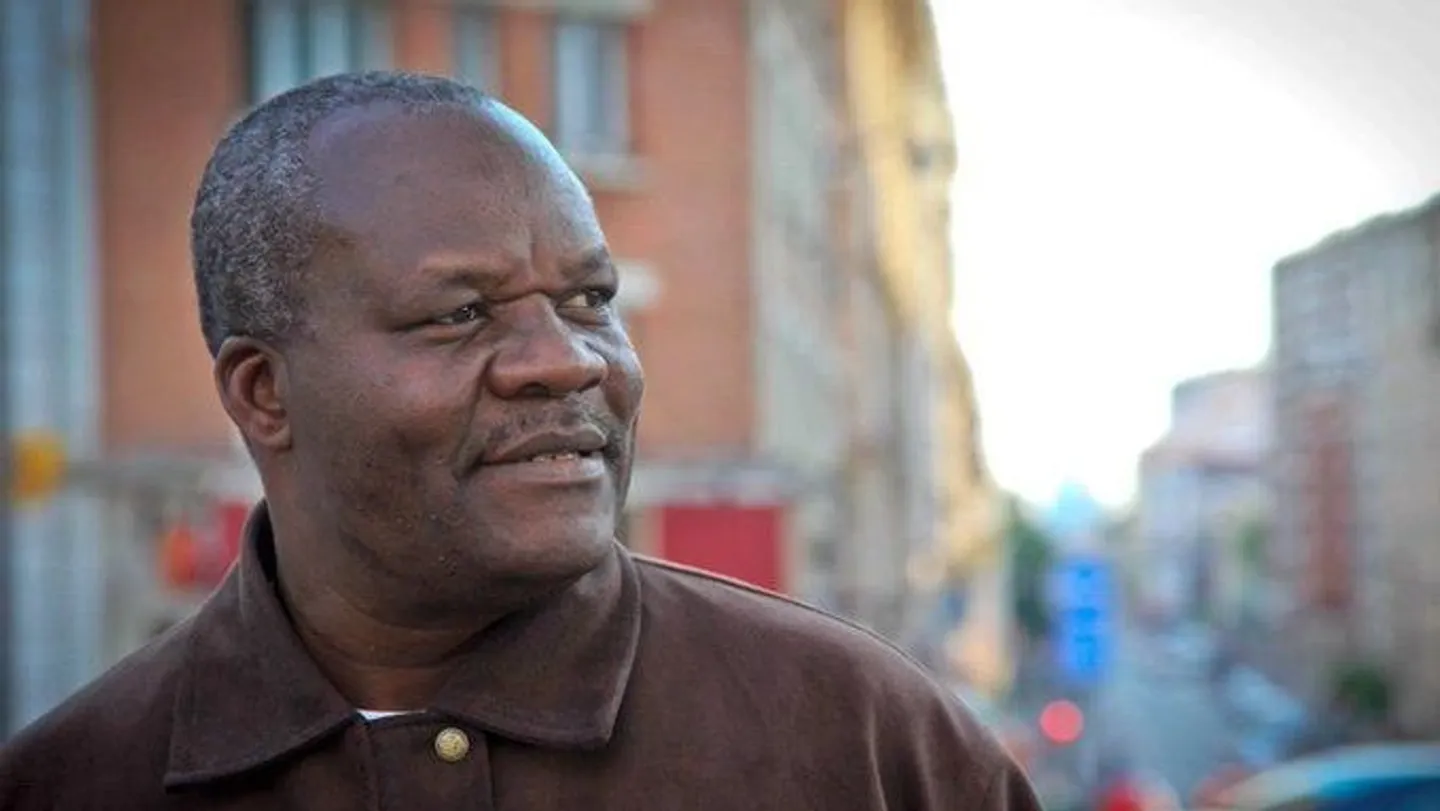
Roger Lumbala, convicted by the French justice system for complicity in crimes against humanity in the DRC, traveled only to hear the verdict on December 15.
Former Congolese rebel Roger Lumbala was sentenced on Monday, December 15, in Paris, to thirty years in prison for complicity in the atrocities committed by his soldiers in 2002-2003, a “historic verdict” which, according to NGOs, “put an end to decades of impunity” in eastern DRC . The National Anti-Terrorist Prosecutor’s Office (PNAT), which has jurisdiction over these crimes, had requested a life sentence, the most severe penalty provided for by the French Penal Code.
Held in custody in Paris for five years, Roger Lumbala, who has ten days to appeal, refused to attend the proceedings, denying any legitimacy to the French justice system and denouncing a biased investigation. But this former insurance agent, who briefly served as a minister in his country in 2004, returned to listen, impassive, to the verdict that found him guilty of complicity “by order” or “by aiding and abetting” crimes committed by his troops.
Rape used as a weapon of war, sexual slavery, forced labor, torture, mutilation, summary executions, systematic looting, extortion, and the plundering of resources (diamonds, coltan, etc.)… For a month, the court listened to accounts of actions committed during Operation “Erase the Slate,” against a rival faction in the northeast of the country by the Congolese Rally for Democracy-National (RCD-N), Lumbala’s rebel group. Supported by neighboring Uganda, the RCD-N was allied with the Movement for the Liberation of Congo (MLC) of the current Congolese Deputy Prime Minister in charge of Transport, Jean-Pierre Bemba .
A sense of impunity is being undermined?
Like the trials in the past concerning the genocide of the Tutsi in Rwanda, the first civil war in Liberia or the abuses of the Syrian regime of Bashar al-Assad, Roger Lumbala was tried under the universal jurisdiction that France can , under certain conditions, claim for crimes against humanity.
Human rights organizations hope that this verdict will undermine the sense of impunity among the warring parties who have been fighting in eastern DRC for thirty years, with the involvement of neighboring countries such as Rwanda and Uganda, and with the main objective of controlling mineral and natural resources.
These wars, whose toll is impossible to establish, have left millions dead and displaced. At the time of the Lumbala verdict, the “peace” agreement ratified in early December in Washington remained a dead letter, and the region continued to be the scene of clashes between the M23 , a group supported by Kigali, and the Congolese army, backed by Burundian forces.
Three warlords, Thomas Lubanga, Germain Katanga, and Bosco Ntaganda, were indeed convicted by the International Criminal Court between 2012 and 2021. However, NGOs point out that no national court of any country claiming universal jurisdiction has yet convicted anyone for atrocities committed in eastern DRC.
An “opportunist” and “one of the masterminds” of the bloody offensive
Operation “Erase the Board” was part of this long series of battles between multiple factions. According to Hervé Cheuzeville, a humanitarian worker who testified, it was “a paroxysm of horror,” “an unprecedented orgy of violence and looting.” The events examined by the court since November 12 are only “the tip of the iceberg” of the atrocities, even if they are “a representative sample,” according to Henri Thulliez, a lawyer for the civil parties.
During the trial, a man explained how his brother had his forearm amputated and then executed after being unable to eat his severed ear; women gave accounts of rapes by soldiers, often in groups and in front of parents, husbands, and children.
The victims were mostly Nande or Bambuti Pygmies, ethnic groups accused by the attackers of siding with a rival faction. Roger Lumbala held “a position of authority” over his troops, according to the prosecution, which dismissed the self-portrait of a mere politician with no real influence over the fighters, a portrait painted by the accused during the investigation.
According to the prosecutors, the accused, who readily posed in uniform and boasted in the press about his soldiers’ conquests, not only allowed them to commit their crimes but “directly participated” in them, certainly not on the front lines, but by supplying them with ammunition and weapons, financed by extorting money from the local population. He was indeed “one of the masterminds” behind this bloody offensive, according to the prosecution.