
Polls open in Tanzania as ruling party seeks to extend decades in power
- On Wednesday, President Samia Suluhu Hassan faces voters in Tanzania against 16 opposition candidates from smaller parties after major rivals were barred.
- The commission’s disqualifications followed the electoral commission barring Chadema in April for refusing to sign an electoral code of conduct and excluding other contenders; opposition leader Tundu Lissu remains imprisoned on treason charges.
- Amnesty International said `Authorities must end their unacceptable campaign of repression against dissent`, while police investigate the former ambassador to Cuba’s abduction earlier this month.
- A Hassan victory would extend Chama Cha Mapinduzi’s long rule, and the U.S. Senate Foreign Relations Committee warned arrests and intimidations undermine democracy and could prompt sanctions.
- Tanzania’s voter rolls show more than 37 million registered voters alongside a $1.2 billion uranium project, but around 50,000 were added to the early-voting roll amid stalled gas talks.
As polls opened in Tanzania on Wednesday, Tanzania’s 2025 presidential race will be without the main opposition parties, leaving the ruling Chama Cha Mapinduzi (CCM) party almost unopposed.
Tanzania’s largest opposition party, Chadema, is boycotting the upcoming presidential election after its leader Tundu Lissu was imprisoned facing treason charges after calling for electoral reforms.
Luhaga Mpina, the presidential candidate for the second-largest opposing party, the Alliance for Change and Transparency (ACT-Wazalendo), has been disqualified by the Independent National Electoral Commission.
Sixteen opposition candidates representing smaller parties are on the ballot but are not expected to be a challenge for President Samia Suluhu Hassan, who is widely expected to win a second term.
President Samia Suluhu Hassan is widely expected to win a second term, especially with the main opponents jailed or barred from running.
Her party, Chama Cha Mapinduzi (CCM), has governed since Tanzania’s independence in 1961.
Experts also say voter apathy could aid Hassan win more than her promises of big infrastructure projects, hiring of school teachers, and universal health insurance.
In 2021, Hassan was praised after taking office for curtailing the political repression and media censorship that marked the rule of her predecessor, John Magufuli.
However, in the past two years, rights groups and opposition figures have accused her government of carrying out abductions of its critics.
In a recent report, Human Rights Watch has said, “the authorities have suppressed the political opposition and critics of the ruling party, stifled the media, and failed to ensure the electoral commission’s independence.”
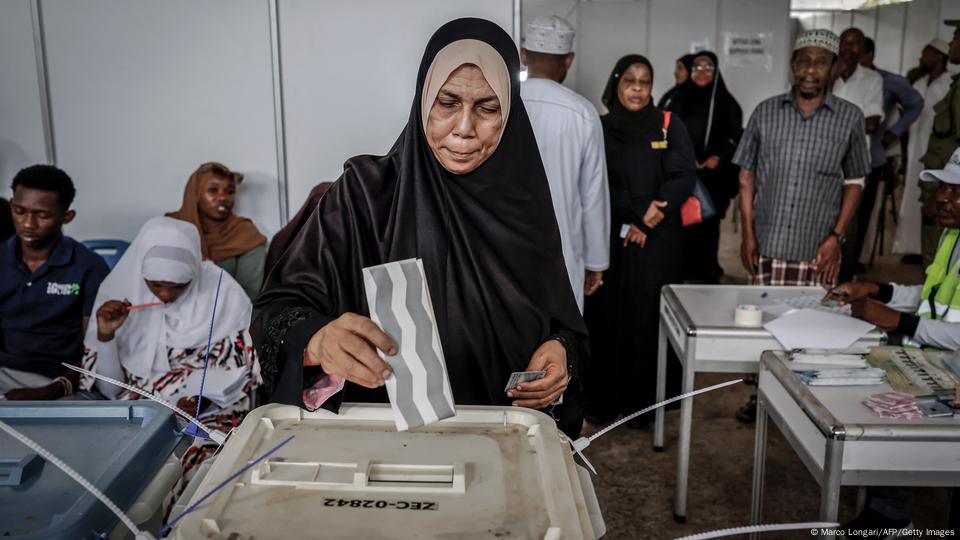
Polling stations across Tanzania opened on Wednesday for presidential and parliamentary elections, with more than 37 million people registered to vote.
Voting began at 7 a.m. local time (0400 UTC), with queues forming at polling places.
The poll stations are scheduled to close at 4:00 pm, after which vote tallying will begin.
Preliminary results are expected within a day, although officials have up to a week to declare the final outcome.
Aside from the president, voters will also elect 400 members of parliament, as well as the president and representative of the semi-autonomous Zanzibar archipelago.
With the ruling party dominating the campaign and opposition calls for protests largely muted, analysts expect President Samia Suluhu Hassan to win comfortably.