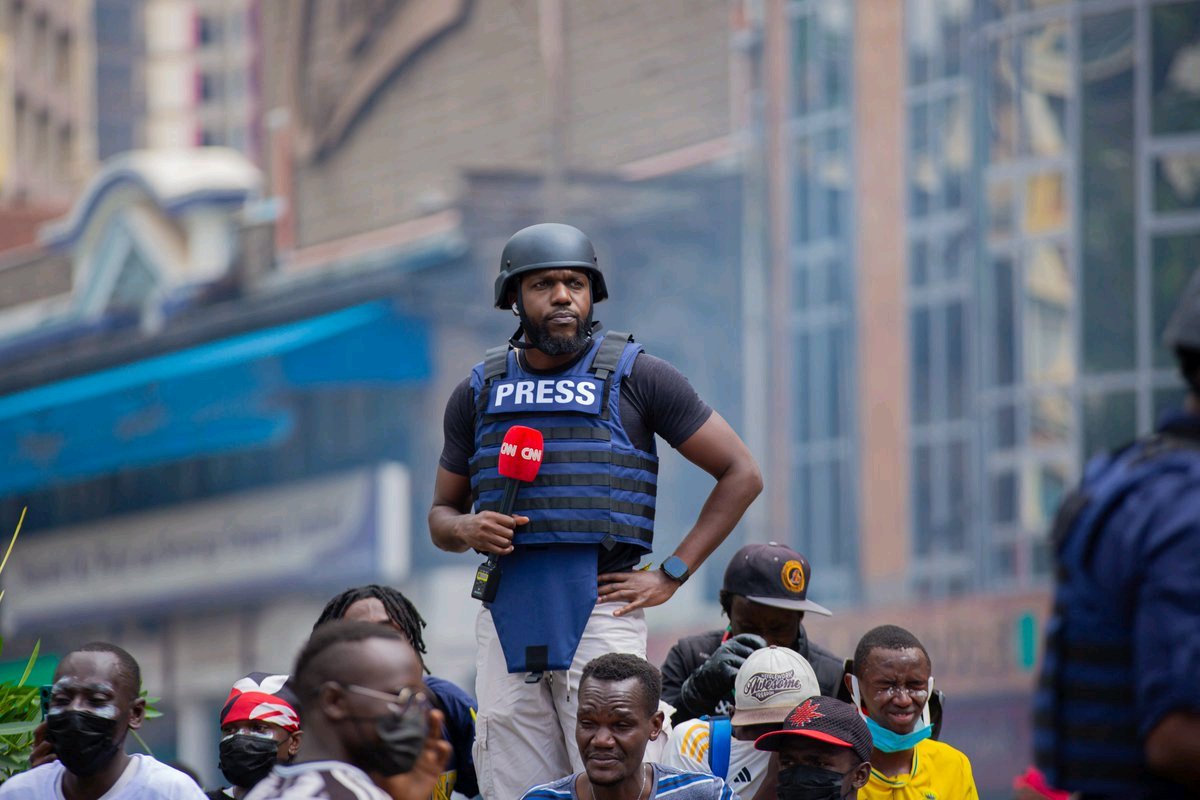
Renowned CNN journalist Larry Madowo has sparked widespread discussion after revealing an unusual sight at Entebbe International Airport that, by his own account, he has never encountered despite travelling through nearly 50 airports every year.
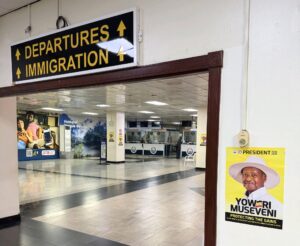
The veteran journalist pointed to the prominent display of a political poster featuring President Yoweri Museveni seeking re-election in Uganda’s 2026 presidential contest, in which opposition leader Bobi Wine is widely viewed as his main challenger.
Madowo’s observation has ignited debate across social and political circles, with many questioning the appropriateness of overt political messaging in a major international transit hub.
Airports are typically regarded as politically neutral spaces, designed to welcome travelers of all backgrounds while projecting a country’s cultural, economic, and tourism appeal.
The presence of a campaign-style political poster in such a setting has therefore struck many as unusual.
Uganda is heading into a highly anticipated election cycle, with President Museveni expected to seek another term after decades in power.
His administration has long emphasized stability and continuity, while critics argue that the political environment remains heavily skewed in favor of the incumbent.
Bobi Wine, a popular opposition figure and musician-turned-politician, continues to attract strong support among younger voters and urban populations, positioning the 2026 election as a potentially defining moment for the country.
The sighting at Entebbe Airport has been interpreted by some analysts as symbolic of how politics permeates public life in Uganda.
Comparatively, most international airports maintain strict rules against political advertising to avoid controversy and ensure neutrality.
Larry Madowo’s comment, therefore, resonated beyond Uganda, prompting regional and international observers to reflect on how political culture varies across countries.
While Ugandan authorities have not issued an official statement regarding the poster, the conversation it has generated underscores the heightened political temperature ahead of the 2026 polls.
It also highlights how seemingly small details in public spaces can carry powerful political meaning, especially when noticed by globally recognized voices.