
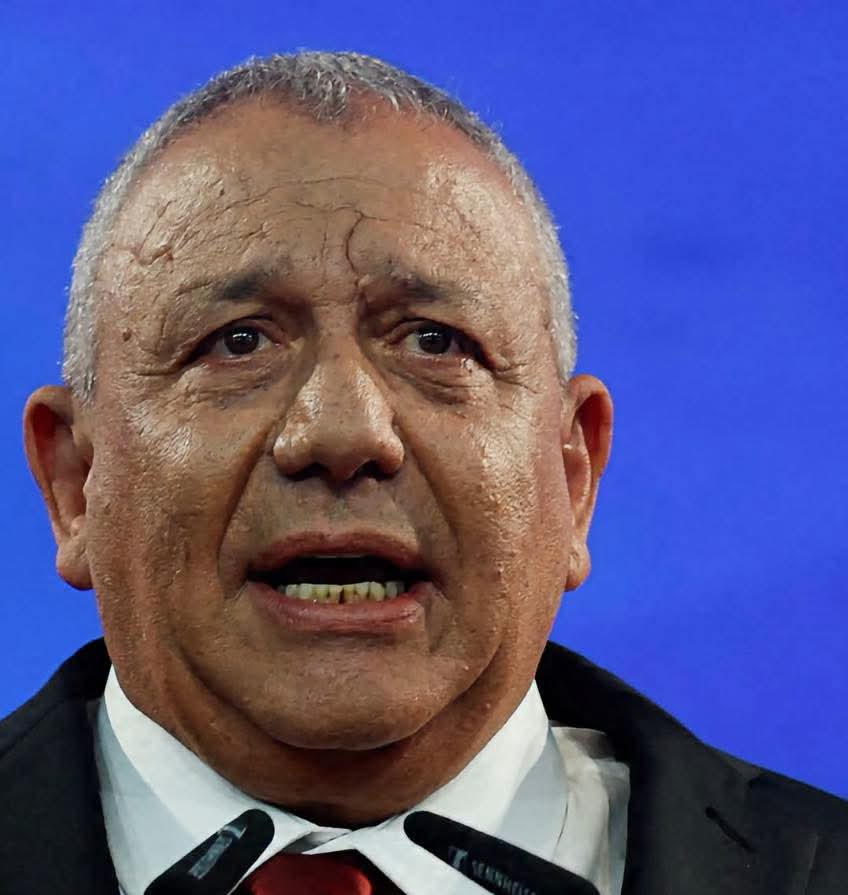
News agencies reported on the 8th (local time) that Gadi Eisenkot, leader of Israel’s opposition Yashar Party, which won the general election last month, has been granted the right to form the next coalition government.
Israeli President Izhak Herzog announced on the 7th that Eisencott has been given priority authority over the formation of a coalition government.
As Eisenkot comes closest to becoming the next prime minister, the possibility of Prime Minister Benjamin Netanyahu being ousted has become very high.
Israeli President Izhak Herzog announced on the 7th that Eisencott has been given priority authority over the formation of a coalition government.
As Eisenkot comes closest to becoming the next prime minister, the possibility of Prime Minister Benjamin Netanyahu being ousted has become very high.
Immediately after the President’s announcement, Eisenkot told X, “Now is the time to form a national emergency government,” adding, “We will do everything possible to prove that we are qualified for it.”
Eisenkot must form a coalition cabinet within 28 days of being granted the right to form a coalition, and if this deadline is missed, the President may extend it by 14 more days. If the official right to form is handed over on the 8th, the deadline for basic negotiations becomes the 6th of the following month, and if extended to the maximum, the deadline becomes the 20th of the following month.
During this period, Eisenkot must reach an agreement with the participating parties on policies and cabinet assignments, then submit the new government to Parliament and request a vote of confidence.
In the general election held on the 27th of last month, both Netanyahu’s camp and Eisenkot’s camp failed to secure 61 seats, a majority in parliament.
Netanyahu’s Likud party and the right-wing and religious parties secured 53 seats, 11 fewer than in the general election four years ago, while the opposition led by Eisenkot took 48 seats. Two Arab parties not belonging to either camp secured a record 19 seats.
Although Netanyahu’s camp has five more seats than the opposition in terms of the number of seats alone, the initiative in forming the next government has shifted to the opposition as Arab parties support Eisenkot.
Prime Minister Netanyahu obstructed the Arab party from joining the opposition by claiming election fraud, but it ultimately failed.
Although Arab parties have lent their support to Eisenkot, this does not immediately mean they will join a coalition or vote of confidence. In particular, as the divisions within Israeli society have deepened over the three years of the Gaza War, cooperation with Arab parties has become a key issue.
Eisencott indicated a willingness to cooperate with Arab political parties on conditions such as classifying Hamas as a terrorist group that must be disbanded
In a video statement just before the President’s announcement, Prime Minister Netanyahu urged the formation of a national unity government and, targeting Arab parties, argued that “a government with supporters of terrorism should not be hastily launched.”
If Eisenkot fails to form a coalition within the set period, the President may delegate the right to form a coalition to another member or notify Congress that there is no possibility of forming a government. The second candidate is given 28 days to negotiate.
If a coalition fails even after the second candidate, or if the President determines that forming one is impossible, the process moves to the stage where Congress recommends a candidate. Members of Congress can request the President to entrust the formation of the cabinet to a specific member by collecting signatures from at least 61 members, which is a majority of the total, within 21 days.
Members of Parliament who have been granted the right to form a government through this procedure have a final negotiation period of 14 days.If the Parliament fails to recommend a candidate within the deadline, or if even the last candidate fails to form a government, the Parliament is dissolved and must hold a general election within 90 days.
Netanyahu can continue to serve as Prime Minister of the interim government until the new government is formed.