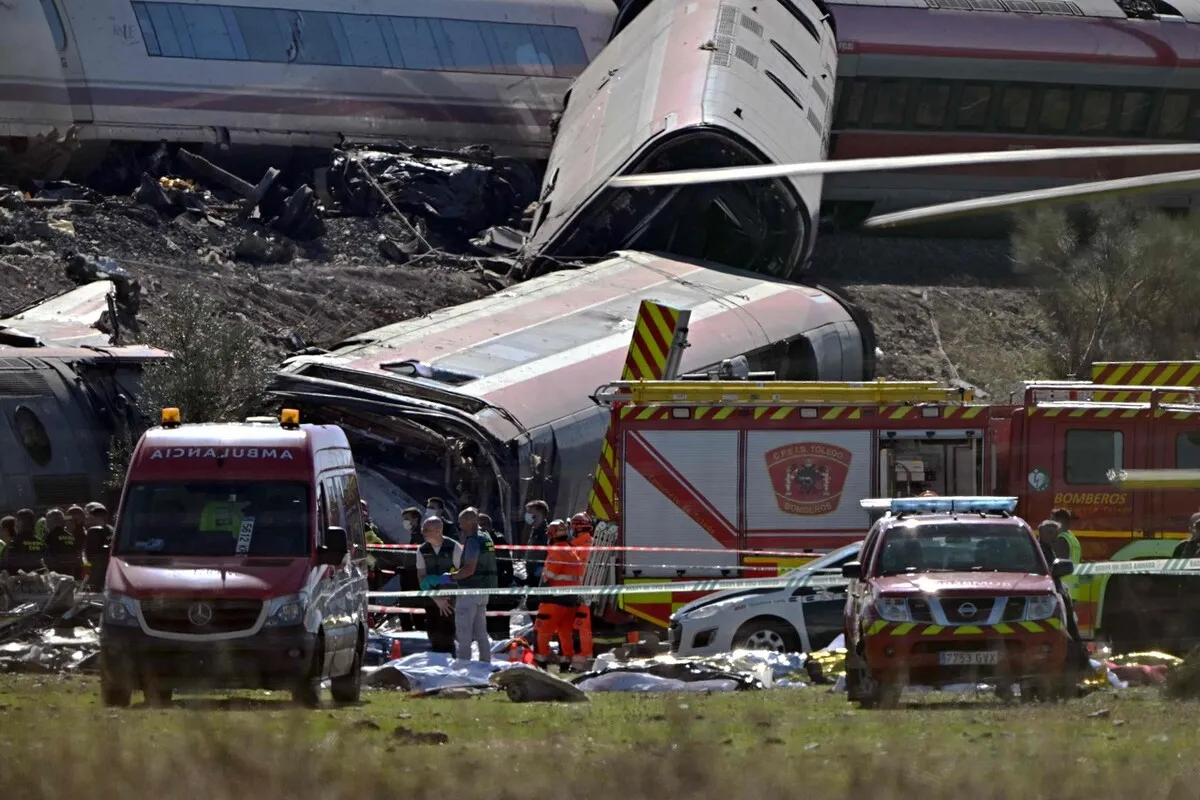
At least 68 people were killed in Spain on the 28th when a high-speed train struck another train that was stopped on the tracks. This is the second major train accident in Spain this year and the deadliest disaster in Europe since 2013.
Reuters and other outlets reported that two trains collided on high-speed tracks in Castilla-La Mancha, south of Madrid, on this day, killing at least 68 people and injuring 80, 15 of whom sustained serious injuries. At the time of the collision, which occurred around 9 a.m., 147 people were on board the privately operated Irho train and 397 people were on board the state-run Renfe train; the impact caused two carriages of the Irho train to derail.
Transport Minister Oscar Fuente explained at a press conference in Madrid that the accident occurred because the operation of a Spanish national railway (Renfe) train was authorized despite a red stop signal being illuminated due to a train that was stopped ahead. He stated that the train’s operation had automatically stopped due to the red signal turning on because of a computer communication failure, but a wrong decision was subsequently made to resume the Renfe train’s operation.
Spain’s state railway company Renfe announced that its train collided with a privately operated Illyo train that had stopped for “unknown reasons” after receiving approval to resume operations. In a statement, Renfe explained, “The collision occurred while the Renfe train was continuing operations in accordance with instructions,” adding that “the specific circumstances of the accident, operating conditions, and the situation of the collision must be determined through an investigation.”
In a televised address near the accident site in southern Madrid, Spanish Prime Minister Pedro Sánchez promised to thoroughly investigate the cause of this “terrible tragedy” and rectify all revealed issues, while adding that the causes of the two accidents that occurred this year do not appear to be related. Prime Minister Sánchez emphasized, “If safety needs to be further strengthened to restore confidence in the high-speed rail system, we will do so,” adding, “It is unacceptable for a country like Spain to have two high-speed rail accidents in a single year.”
A preliminary investigation report by the Spanish security forces, released last February, identified defects in the tracks or rails, or poor welding between the tracks, as the primary cause of the January accident. Investigators are also keeping seven other possibilities open.
This disaster is the deadliest railway accident in Europe since the 2013 Santiago de Compostela derailment in Spain, which killed 80 people. This accident follows a collision last January on the same line between high-speed trains operated by the same railway operator that killed 46 people. That accident sparked a fierce debate regarding investment in railway maintenance after the train derailed and collided head-on with an oncoming train.