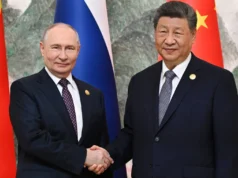
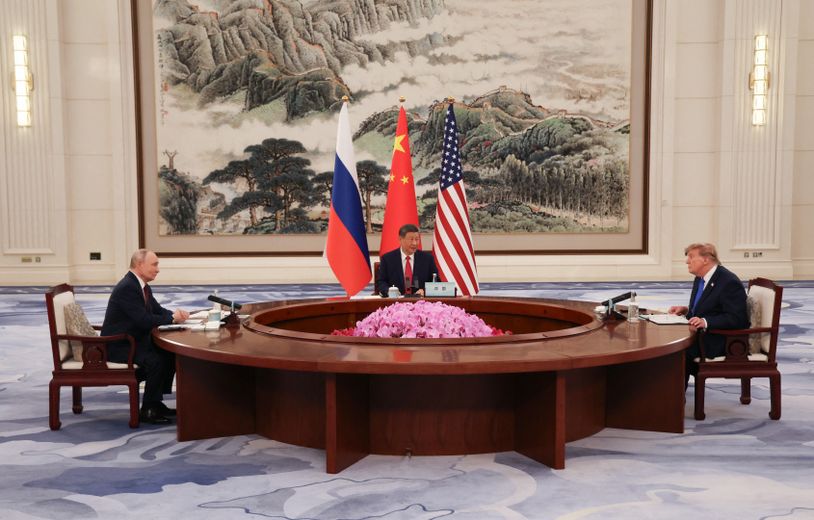
Meeting for a historic summit in China, Donald Trump, Vladimir Putin, and Xi Jinping adopted a peace declaration with very vague commitments. This diplomatic operation appears to be the main beneficiary of the Chinese president, while Vladimir Putin intensifies his threats against Ukraine and the Europeans attempt to influence the negotiations.
When the announcement came of a meeting between Vladimir Putin, Donald Trump and Xi Jinping in Shenzhen, on the sidelines of the Asia-Pacific Economic Cooperation (APEC) summit, some immediately drew parallels with the Yalta conference, during which Stalin, Roosevelt and Churchill laid the foundations of the international order, from February 4 to 11, 1945, at the Livadia Palace in Crimea.
The Russian president is embroiled in a war he started in Ukraine and from which he doesn’t know how to extricate himself, ready to escalate the situation even at the cost of exhausting his country. The American president, who has just suffered a resounding defeat in the midterm elections, is a lame duck, also embroiled in a war, in Iran, from which he doesn’t know how to extricate himself.
One, having become a pariah on the international stage, needed to reconnect with an international summit to show he wasn’t isolated; the other, fascinated by his autocratic interlocutors, needed to reclaim his presidential status far from Washington. Xi skillfully played on the egos of his interlocutors, establishing himself almost as the adult in the room and reinforcing his ambition to place China at the center of the world stage.
Peace, nuclear power, energy and artificial intelligence
For eighty minutes, the three men discussed peace, nuclear power, energy, and artificial intelligence. “We are truly making history,” Trump exclaimed. Xi hailed the meeting as “groundbreaking,” and Putin called the discussion “very useful.”
The joint declaration, one page and four points, promises “strategic stability” and a dialogue on reducing nuclear risks, but no timetable is specified nor even a verifiable commitment.
She argues that a nuclear war cannot be won, calls for UN reform, challenges the International Criminal Court, and envisions increased oil supplies. In short, a catalog of good intentions and criticism of multilateralism, but certainly not a peace agreement.
The differences, moreover, did not disappear behind the smiles, handshakes, meaningful glances, and gestures of closeness. Trump rejects any “globalist” regulations that would hinder the artificial intelligence race, which the United States is currently leading. Xi, on the other hand, wants to keep it “under human control.” Beijing and Washington remain clearly rivals on AI.
Putin promises reprisals in Ukraine
As for the war in Ukraine, the American president insists he wants to end it, while Moscow continues its offensive. Having barely left this peace summit, Putin has already promised “even more painful” reprisals following the Ukrainian strikes against the Crimean bridge.
He also rejected the idea of military cooperation between Ukraine and the Europeans – “Any form of military cooperation obviously poses a problem” – whom he invited to come to Moscow. The Kremlin thus intends to exert influence not only on the conditions but also on the security guarantees. And unsurprisingly, he once again trotted out the same old fallacious narrative that Ukraine started the war.