
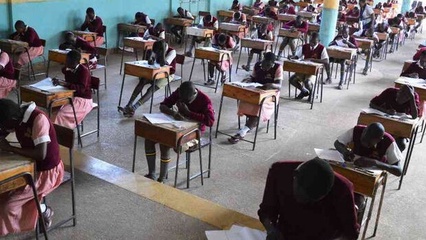
Over 2.4 Million Students Sit for National Exams Under Tightened Security Measures
Kenya’s education sector marked a major milestone today as more than 2.4 million Grade Six and Grade Nine learners began their national transition exams under the Competency-Based Education (CBE) system.
The assessments will determine learners’ progression to junior and senior secondary school, setting the tone for the next phase of Kenya’s education reforms.
A Nationwide Exercise Under Tight Security
By sunrise, examination officials were already unlocking secure storage containers across the country, distributing tightly guarded materials to thousands of centers.
The Kenya National Examinations Council (KNEC) confirmed that more than 2.4 million learners are sitting for various assessments this year — spanning primary, junior, senior, special needs, and pre-vocational levels.
Among them, 1.3 million candidates are participating in the inaugural Kenya Junior School Education Assessment (KJSEA), a landmark moment in the rollout of the CBE system.
To safeguard the integrity of the exams, the government has introduced new security and tech measures. For the first time, KNEC is piloting smart digital padlocks on 250 exam storage containers.
The locks are connected to the KNEC Command Centre, providing real-time tracking of when and where containers are opened or closed — a move officials say will ensure transparency and accountability.
Despite the smooth rollout in most areas, some schools faced delays. At Endikir School in Kajiado County, assessments were postponed for several hours after materials for both the KPSEA and KJSEA failed to arrive on time.
Education officials later assured that affected learners would complete all their scheduled papers and catch up with others by Tuesday.
Meanwhile, in Kasarani, two Grade Nine candidates at Shining Hills School in Njiru were unable to sit for their exams after it emerged they were not registered in the KNEC Portal.