Trump Questions Putin’s Commitment: President Donald Trump expressed skepticism on Saturday regarding Russian President Vladimir Putin’s willingness to conclude the war in Ukraine, casting doubt on the likelihood of achieving a peace agreement in the near future.
This statement followed Trump’s previous assertion just a day prior that Ukraine and Russia were “very close to a deal.”
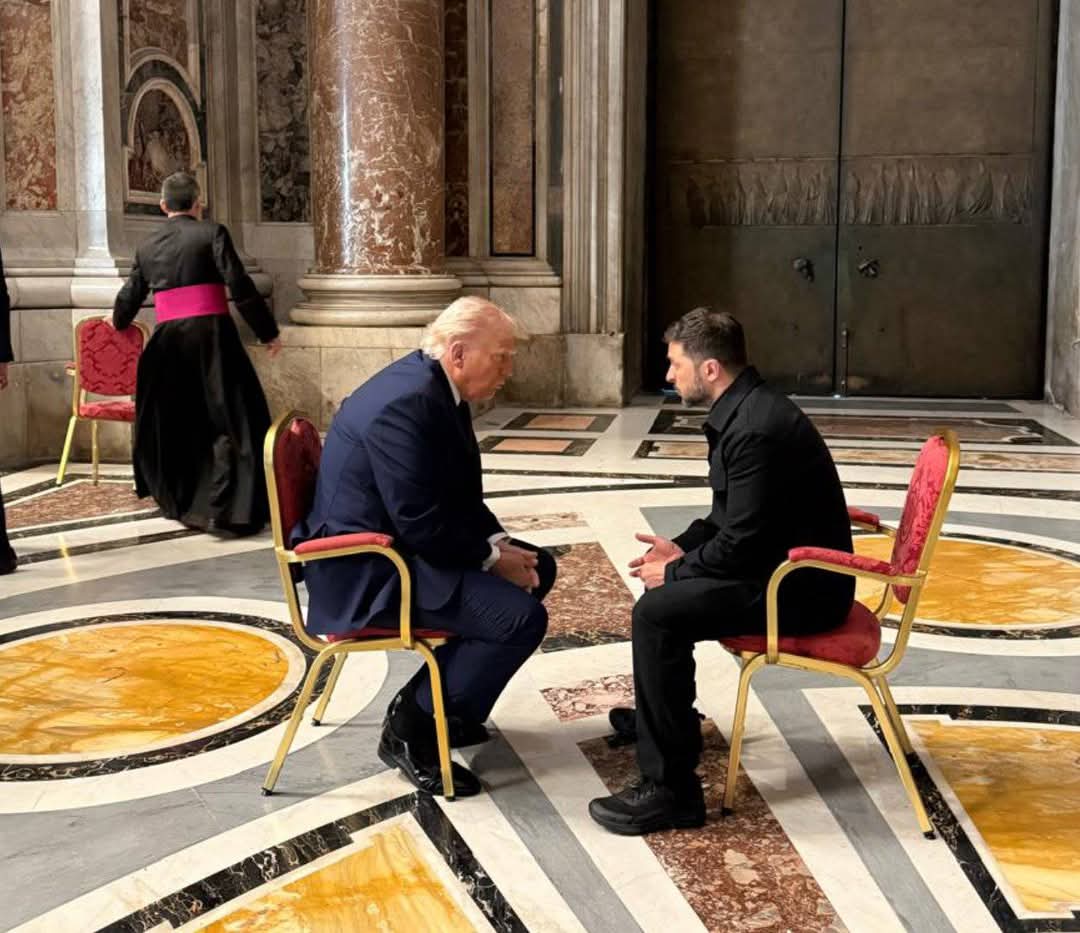
In a social media post while returning to the United States after attending Pope Francis’ funeral at the Vatican, where he briefly interacted with Ukrainian President Volodymyr Zelenskyy, Trump remarked, “There was no reason for Putin to be shooting missiles into civilian areas, cities and towns, over the last few days.”
Trump also suggested the possibility of imposing additional sanctions on Russia, stating, “It makes me think that maybe he doesn’t want to stop the war, he’s just tapping me along, and has to be dealt with differently, through ‘Banking’ or ‘Secondary Sanctions?’ Too many people are dying!!!”
These new reservations from Trump arise as he and his senior advisors intensify their efforts to negotiate an end to the conflict that commenced in February 2022 with Russia’s invasion of Ukraine.
His comments starkly contrasted with his earlier positive assessment that the two nations were nearing an agreement following a meeting between his special envoy, Steve Witkoff, and Putin in Moscow on Friday.
The encounter between Trump and Zelenskyy at the pope’s funeral marked their first face-to-face discussion since a contentious meeting in the Oval Office in late February, which resulted in a temporary halt of U.S. military aid and intelligence support to Ukraine.
Days after that meeting, Trump indicated he was “strongly considering” new sanctions and tariffs against Russia to encourage genuine negotiations from Putin. However, he has yet to act on this threat, despite pressure from some Republican supporters. Notably, when Trump announced new global tariffs earlier this month, Russia was excluded from these measures.
On Friday, U.S. Senator Chuck Grassley, a Republican from Iowa, urged Trump to impose stringent sanctions on Putin, asserting that there is “clear evidence that he is playing America as a patsy.”
This marks the second occasion within a short timeframe that Trump has criticized Putin publicly, a rarity for the former president. On Thursday, he urged the Russian leader to “STOP!” following a series of deadly attacks on Kyiv.
After their brief conversation on Saturday, Zelenskyy’s office announced plans for further discussions between the U.S. and Ukrainian teams, but Trump proceeded directly to the Rome airport to board Air Force One for his return to the U.S.
Zelenskyy’s spokesperson, Serhii Nykyforov, noted that the two leaders did not have a subsequent in-person meeting due to their busy schedules. Zelenskyy described their initial meeting as “good” on social media, expressing hope for results on various issues, including the protection of lives, a complete and unconditional ceasefire, and the establishment of lasting peace to prevent future conflicts.
Zelenskyy also held discussions with British Prime Minister Keir Starmer, French President Emmanuel Macron, and European Commission President Ursula von der Leyen on the same day. He called the meeting with Trump “very symbolic” and expressed optimism about its potential historic significance if collaborative outcomes are achieved.
The White House characterized the Trump-Zelenskyy dialogue as “very productive,” lasting roughly 15 minutes inside St. Peter’s Basilica, a venue where Pope Francis has frequently advocated for a peaceful resolution to the war. The fact that Trump and Zelenskyy spoke privately in such a significant location on the day of the pope’s funeral seemed fitting in light of the pope’s peace efforts.
Upon arriving in Italy late Friday, Trump stated on social media that Russia and Ukraine should engage in “very high level talks” to end the conflict. There has been no response from either Putin or Zelenskyy regarding Trump’s proposal for direct negotiations.
While Trump has urged both parties to swiftly reach a resolution, Zelenskyy has consented to an American plan for an initial 30-day cessation of hostilities, which Russia has yet to endorse, continuing its offensive operations within Ukraine.
Putin was absent from the funeral and is facing an arrest warrant from the International Criminal Court for alleged war crimes linked to the invasion of Ukraine.
In a statement on Friday night, Zelenskyy indicated that “very significant meetings may take place” soon and reiterated his call for an unconditional ceasefire, emphasizing the need for real pressure on Russia to accept either the American proposal or Ukraine’s own plan to ensure a reliable and immediate ceasefire leading to a dignified peace and security guarantees.
“Diplomacy must succeed. And we are doing everything to make diplomacy truly meaningful and finally effective,” he asserted.
The meeting on Saturday coincided with Trump’s most explicit remarks about the necessity for Ukraine to concede territory to Russia to facilitate an end to the war. In a Time magazine interview released on Friday, he stated, “Crimea will stay with Russia.” This region was annexed by Russia in 2014, prior to the full-scale invasion in 2022. While Zelenskyy seeks to reclaim Crimea and other territories taken by Russia, Trump deems such aspirations unrealistic.
Since the invasion began in February 2022, Russia has also occupied Ukrainian areas in Luhansk, Donetsk, Zaporizhzhia, and Kherson