Trump increases pressure on Zelensky
The Ukrainian president could end the war “almost immediately”—that’s what US President Trump claims. But under what conditions? Before the meeting with Trump, Ukrainian President Zelenskyy emphasised what was important to him.
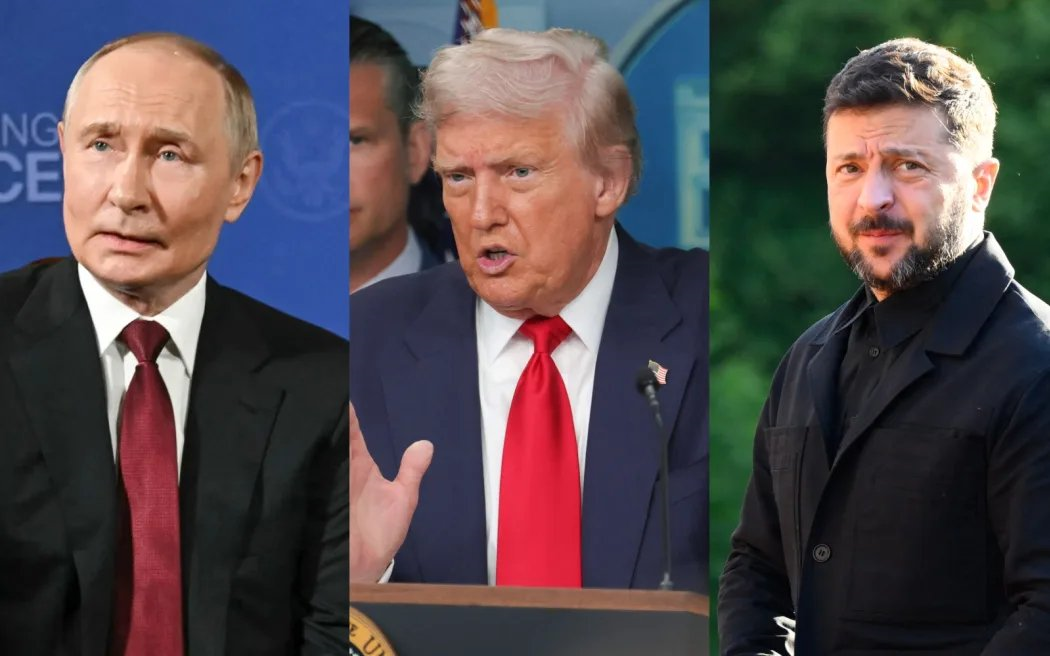
First the conversation with Kremlin chief Vladimir Putin in Alaska, now a meeting with Ukrainian President Volodymyr Zelensky and other leading European politicians: US President Donald Trump wants to negotiate a peace agreement for Ukraine. In doing so, he is now clearly distancing himself from Kyiv.
For example, Trump wrote on his Truth Social platform: “Ukrainian President Zelensky can end the war with Russia almost immediately if he wants, or he can keep fighting.” This statement brings back memories of Trump’s previous statements. He had already blamed the Ukrainian for being partly responsible —and at times even solely responsible—for the war of aggression launched by Russia in 2022.
No return of Crimea, no NATO accession
The US President also made it clear that he considers Ukraine’s accession to NATO and the return of the Black Sea peninsula of Crimea, annexed by Russia in 2014, unrealistic. “Some things never change!!!” he wrote, referring to similar demands from the Ukrainians. Trump referred to the annexation of Crimea, which was tolerated by then-US President Barack Obama, and added: “No NATO accession for Ukraine.”
The US president thus reinforced Russia’s demands regarding a possible peace solution. Putin has repeatedly emphasized that the return of Crimea and Ukraine’s accession to NATO are out of the question for him.
Zelenskyy: Peace must be lasting
Zelensky responded with a lengthy message on Platform X. Russia must end this war, which it itself started. “And I hope that our joint strength with America and our European friends will force Russia to a genuine peace,” Zelensky wrote.
He also warned against questionable agreements. Peace must be lasting. “Not like years ago, when Ukraine was forced to give up Crimea and part of our east – part of the Donbas – and Putin simply used this as a springboard for a new attack.” Zelenskyy also pointed out that the “security guarantees” Ukraine received in 1994 had not worked.
Meeting at the White House
Trump will receive Zelensky and several leading European politicians at the White House today – three days after the summit with Putin in Alaska. Participating in the talks will include German Chancellor Friedrich Merz (CDU), French President Emmanuel Macron, British Prime Minister Keir Starmer, EU Commission President Ursula von der Leyen, and NATO Secretary General Mark Rutte.
A central issue will be the attitude toward Russian territorial claims. Russia insists that Ukraine recognize its territorial losses and reportedly also demands the entire Donbas. Zelenskyy categorically rejected this.
Since the Alaska summit between Trump and Putin, unconfirmed media reports have been increasing that the US president sees the possibility of a quick peace agreement – if Ukraine cedes the entire Donbas to Russia. This would mean Kyiv relinquishing territory that is not yet under Russian control.
Discussion on security guarantees
Another important topic: security guarantees for Ukraine. This refers to measures to protect against attacks. One possibility would be Ukrainian accession to NATO, but Moscow is determined to prevent this. Instead, the scenario of a NATO-like promise of protection to Ukraine from the US and European states is currently being discussed.
“We were able to sort of work around that and reach an agreement that the United States could provide protection similar to Article 5,” US Special Representative Steve Witkoff told CNN. He added that this was the first time the Russians had agreed to such a scenario.
Article 5 of the NATO Treaty stipulates that “an armed attack against one or more of them in Europe or North America shall be considered an attack against them all.” Unlike the original Article 5, however, in the scenario under discussion, the entire Atlantic Alliance would not step in. Instead, the United States and European countries would be responsible.
From the European side, however, expectations are not all that high. French President Emmanuel Macron expressed skepticism about Russia’s possible peace plans. He does not believe Putin is striving for peace. “Do I think President Putin wants peace? The answer is no,” Macron said. “I believe he wants Ukraine’s surrender.”