
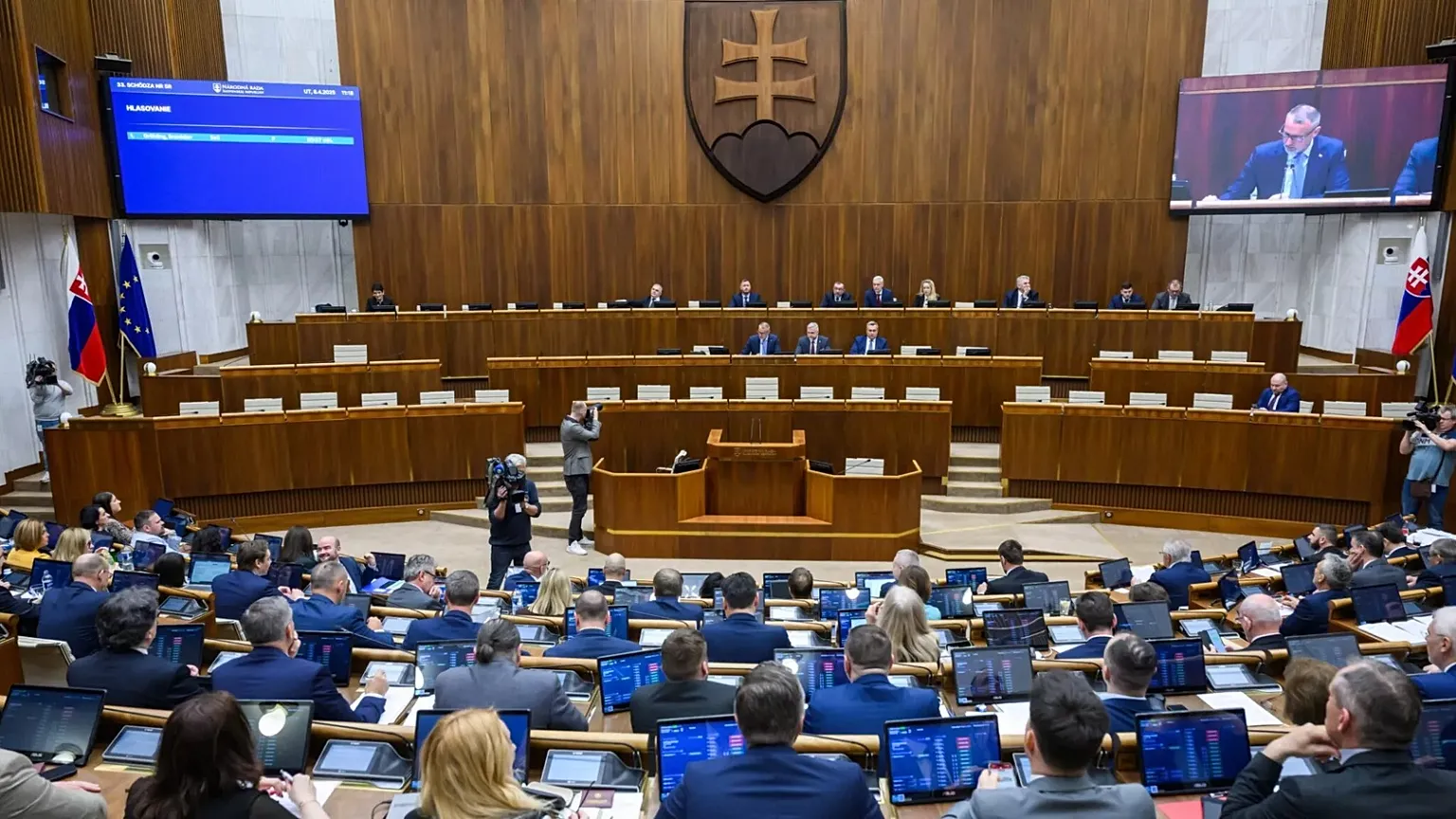
Slovakia passes law to recognise only two sexes and restrict adoption
The amendment restricts adoption to married couples, bans surrogacy, and asserts national law over EU law in culture and ethics, passing with 90 votes in parliament.
- Slovakia’s parliament passed a constitutional amendment stating that national law will take precedence over European Union legislation regarding national identity, achieving 90 votes in favor and 7 against.
- The amendment includes a clause that only married couples will be allowed to adopt children and bans surrogacy.
- The revised constitution states that Slovakia recognizes only two sexes, male and female, and outlines conditions for changing gender.
- National legislation will guide decisions on education, family life, and ethical matters.
After the Hungarian constitution, the Slovak constitution also included the provision that the mother is a woman and the father is a man, Napunk wrote .
On Friday, the Slovak legislature approved the constitutional amendment proposed by Prime Minister Robert Fico’s party for the second time. Among other things, the following was added to the Basic Law:
- In Slovakia, only male and female genders are recognized,
- men and women are entitled to equal pay,
- restrict the conditions for adoption
- and they ban surrogacy.
In Slovakia, a three-fifths majority is required to amend the Basic Law. The current constitutional amendment was adopted by the 150-member Bratislava legislature with 90 votes in favor and 7 against, with 99 members present for the vote, MTI reported.
In addition to representatives of the Smer–Hlas–SNS coalition, representatives of the Christian Democratic Movement (KDH) and Igor Matovič’s Slovensko movement also supported the constitutional amendment. Fico thanked the representatives for supporting the constitutional amendment, which he called a historic step, and reiterated that “liberalism and progressivism are destroying Europe.”
The approved amendments stipulate that Slovakia recognizes only male and female genders, and that gender reassignment may only be carried out in extremely justified cases. According to the new constitution, surrogacy will be prohibited, and the child will have the right to know its parents. Another important element of the constitutional amendment is that it stipulates equality between men and women in terms of remuneration for work performed.
Regarding sex education in schools, it was also voted that only curriculum materials that are in line with the fundamental principles of the constitution may be included in educational institutions, and communications that contradict these may only be made if parents expressly give permission.
According to the justification, the constitutional amendment will help to establish Slovakia’s sovereignty in cultural and ethical matters, strengthen the protection of traditional values, and is also crucial for legal stability. According to Fico, this makes it clear that neither the legal norms of the European Union nor international treaties have priority over the Slovak Constitution, if they contradict the fundamental principles set out in the latter.
This was the 22nd amendment to the Slovak Constitution, which was created in the fall of 1992. The amended constitution will enter into force on November 1st after approval by the head of state.