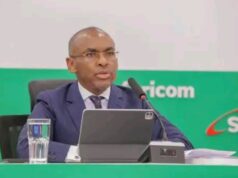
The government plans to sell 6 billion Safaricom shares under Sessional Paper No. 3 of 2025. The sale aims to raise KSh244.5 billion through a mix of share pricing and advance dividends.
The government’s latest plan to sell a 15 per cent stake in Safaricom has sparked intense national debate. The proposal, contained in Sessional Paper No. 3 of 2025, targets approximately KSh244.5 billion in proceeds.
A notice from Parliament shows that the joint committee of Finance and National Planning and the Public Debt and Privatisation Committee is inviting submissions from shareholders, customers, employees, regulators and the public.
Under the plan, the government seeks to sell 6 billion shares—equivalent to 15 per cent of its holding—while retaining a 20 per cent strategic stake in the telecom company.
Based on a proposed price of KSh34 per share, the state expects to raise KSh204.3 billion, while Vodacom Group is projected to contribute an additional KSh40.2 billion as an advance dividend.
The Treasury says the divestment will help generate non-tax revenue for major infrastructure investments in energy, transport, water, aviation and digital sectors. It argues that the sale will ease pressure on borrowing and improve Safaricom’s competitiveness by increasing market-driven ownership.
According to the proposal, government influence will remain through two board seats and specific oversight provisions. Vodacom has also pledged to retain Kenyan leadership on the board, maintain support for the Safaricom Foundation, and avoid job cuts for at least three years.
Despite these assurances, political and public criticism is growing. Many leaders argue that the government may be selling a valuable national asset below its true worth.
Kiharu MP Ndindi Nyoro said the proposed KSh34 price is far below Safaricom’s previous highs and reflects undervaluation.
“The KSh34 per share price severely undervalues Safaricom compared to its KSh45 price in 2021. The plan now places Safaricom below KSh1.4 trillion, nearly 24 per cent lower than its 2021 valuation of KSh1.8 trillion.”
— Ndindi Nyoro
Nyoro warned that the rushed process and lack of wide consultation could deny Kenyans full value.
Former Deputy President Rigathi Gachagua has also rejected the proposal, accusing the government of disposing of profitable state assets without proper public engagement. He argued that Safaricom’s real worth is much higher.
“Safaricom shares are worth between KSh70 and KSh80. Selling at this level could make the country lose roughly KSh250 billion in value.”
— Rigathi Gachagua
Gachagua compared the move to selling a productive cow that feeds a family, warning that short-term revenue gains could worsen Kenya’s long-term financial position.