Malawi on the eve of a Chakwera-Mutharika duel for the presidential election on September 16
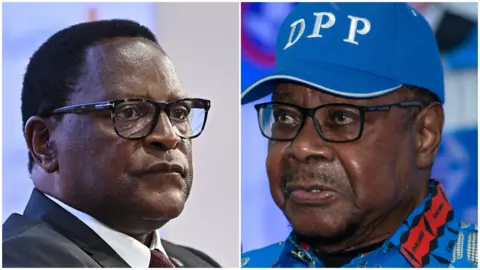
In Malawi, voters will head to the polls this Tuesday, September 16, to elect their new president. Seventeen candidates are in the running, including the 70-year-old incumbent Lazarus Chakwera and his historic rival, 84-year-old Peter Mutharika. But beyond the poster, the real challenge remains turnout. Only 7.2 million voters are registered, while it is estimated that more than 11 million Malawians are of voting age.
In Malawi, 70-year-old evangelical pastor-turned-president Lazarus Chakwera is asking for “five more years ” to finish the job. In 2020, he promised to revive the economy and fight corruption. But his five-year term has been marked by record inflation and the Sattar scandal, named after a businessman accused of bribing several Malawian officials, which prompted his vice president to resign.
Facing him, Peter Mutharika, 84, is banking on the current government’s rejection.
A former law professor and president from 2014 to 2020, he promises to restore fiscal discipline and protect whistleblowers. But he too carries a heavy legacy: violence by his “juniors,” groups of young supporters accused of intimidation, and the Cashgate corruption scandal, inherited from his predecessor, Joyce Banda.
Despite their differences, the two men share a common handicap: a disillusioned electorate. According to analyst Michael Jana, they recycle the same promises, without accounting for their past performance. And in a country where only 7 million voters have registered out of 11 million of voting age, the future president risks having a weakened mandate.
Participation: a key element of the vote
The low turnout is what civil society is concerned about, fearing that with so few registered voters, the next president will lack true legitimacy. This is what Boniface Chibwana of the Centre for Multiparty Democracy fears, at least. He told RFI’s Christina Okello . ” This is really one of the points to watch: will voters turn out en masse? Otherwise, the next president will not have a legitimate mandate in a divided country. However, when you look at the enthusiasm, turnout is clearly declining .”
And this disaffection primarily affects young people, who are the majority in Malawi. Many no longer even register, according to Charles Kajoloweka, executive director of the NGO Youth and Society. ” It’s an election of dinosaurs; there’s very little that represents the new generation. And with the recent death of Vice President Saulos Chilima, who for many embodied the aspirations of young people, we’ve seen even more young people turn away from politics .”
A paradox: the youth vote was decisive in 2019, contributing to the cancellation of the election that had given Peter Mutharika the victory. Their mobilization or abstention could once again carry significant weight this year.