
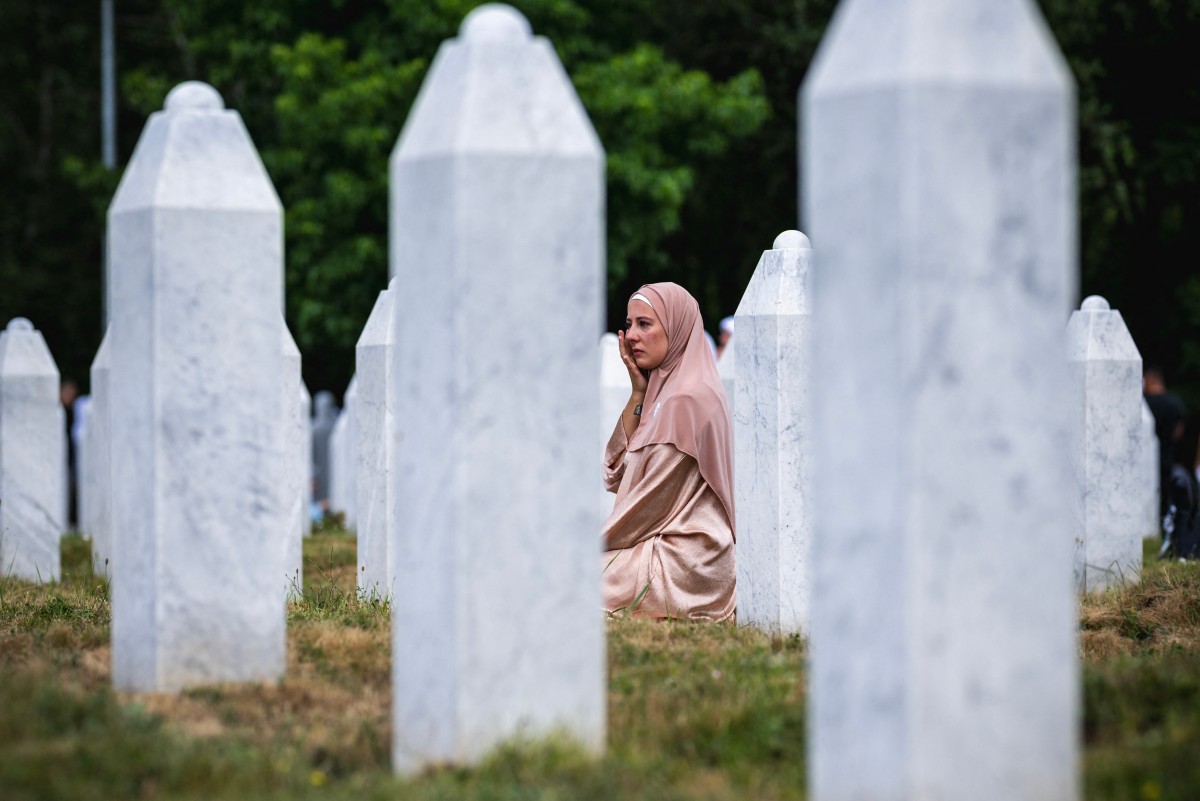
Bosnia Commemorates 30 Years Since the Srebrenica Genocide
Srebrenica, Bosnia and Herzegovina: On Friday, thousands assembled to honor the victims of the genocide carried out by Bosnian Serb forces three decades ago in Srebrenica, marking one of the most tragic events in Europe since World War II.
During the memorial service held in the eastern town, the remains of seven victims were laid to rest, reflecting on the darkest period of Bosnia’s inter-ethnic conflict in the 1990s.
Among those interred was Sejdalija Alic, one of over 8,000 Muslim men and boys who perished when Bosnian Serb forces captured Srebrenica on July 11, 1995.
His granddaughter, Anela Alic, attended the funeral, having previously lost her father in the massacre, who had been buried earlier.
“I never met my father… and today, my grandfather is being buried, with only fragments of his bones beside his son,” the 32-year-old shared tearfully. She was born in early 1994 after her pregnant mother was evacuated from the besieged town by a Red Cross convoy.
The victims of Srebrenica, which was designated as a UN-protected enclave at the time, were buried in mass graves.
To date, around 7,000 victims have been identified and interred, while approximately 1,000 individuals remain missing.
In an attempt to obscure the crime, Bosnian Serb forces moved remains to secondary mass graves, often resulting in the dismemberment of bodies due to heavy machinery, as noted by experts.
A Tombstone to Caress
“For 30 years, we have carried this pain within us,” remarked Munira Subasic, president of the Mothers of Srebrenica association.
She lost her husband, Hilmo, and her 17-year-old son, Nermin, during the massacre.
“Our children were innocent victims in a UN-protected zone. Europe and the world stood by in silence as they were killed.”
The seven victims interred under white tombstones at the memorial center following a joint prayer included a 19-year-old man and a 67-year-old woman.
Experts indicated that most remains are incomplete, with some consisting of only one or two bones.
Families have endured long waits to bury their loved ones, hoping for the discovery of more remains.
However, Mevlida Omerovic chose not to delay any further in burying her husband, Hasib, who was killed at the age of 33 at one of the massacre’s five execution sites, the only atrocity from Bosnia’s 1992-1995 war recognized as genocide by international courts.
“Thirty years have passed, and I have nothing left to wait for,” said Omerovic, 55.
She wishes to visit her husband’s grave, even though only his jawbone will be interred.
“I have only this tombstone to caress and to pray beside,” said Sefika Mustafic, standing by the graves of her sons, Enis and Salim, both teenagers at the time of their deaths.
“I wish I could dream of them, but it never happens. I have pleaded thousands of times, ‘Come, my children, come into my dreams’… I say it when I pray, when I come here, but it never works.”
Denial from Serb Officials
Canadian veteran Daniel Chenard, who served with UN peacekeepers in Srebrenica from October 1993 until March 1994, attended the memorial, burdened by years of guilt.
“I have forgiven myself… I found peace. I always wanted to tell the families of the victims: ‘I apologize… I’m sorry for abandoning you.’
“We (UN troops) did what we could… but the tragedy still occurred,” the 58-year-old said, visibly emotional.
Radovan Karadzic and Ratko Mladic, wartime political and military leaders of the Bosnian Serbs, were sentenced to life imprisonment by an international tribunal, particularly for the genocide in Srebrenica.
Nevertheless, Serbian and Bosnian Serb leaders continue to reject the characterization of the massacre as genocide.
Last year, the United Nations established an international day of remembrance for the genocide, despite opposition from Belgrade and Bosnian Serb officials.
While Serb officials deny the genocide label, President Aleksandar Vucic expressed condolences to the families of Srebrenica victims on behalf of the Serbian people on Friday, describing it as a “terrible crime.”
“We cannot alter the past, but we must strive to change the future,” he posted on X.
Marta Kos, the European Union’s enlargement commissioner, who attended the memorial, remarked, “Srebrenica remains a profound scar on European history.”
“It is our responsibility to remember,” she stated.
On Friday evening, several dozen individuals gathered in central Belgrade to light candles in honor of the massacre victims.