At least 42 dead in Mexico as heavy rain sets off floods and landslides
More than 34,000 homes were damaged in 117 municipalities.
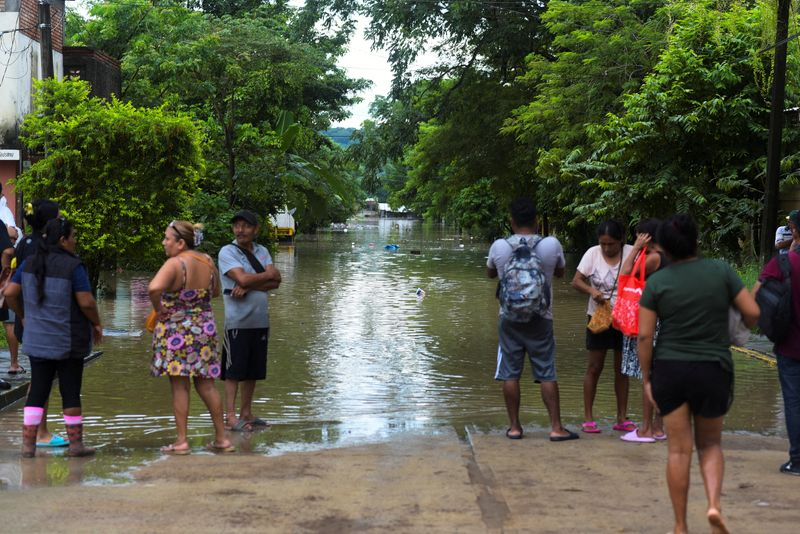
Forty-two people dead, 27 missing, and more than 34,000 homes affected in some 117 municipalities across five states is the damage tally reported as of last night by authorities at all three levels of government following the rains caused by tropical storms Priscilla and Raymond , along with other meteorological phenomena in the Gulf of Mexico.
The National Civil Protection Coordination (CNPC) reported that 16 deaths have been recorded in Hidalgo, 15 in Veracruz, nine in Puebla, and one in Querétaro. However, Puebla Governor Alejandro Armenta confirmed that the total number of deaths in that state is 10, and eight people are still missing.
In Veracruz, 55 districts have been reported damaged, primarily in Álamo Temapache, Poza Rica, Tuxpan, El Higo, Tempoal, and Ilamatlán. In total, 16,000 homes have been damaged, and naval personnel have assisted more than 2,000 people.
In Puebla, 37 municipalities were identified with 16,000 homes affected; in San Luis Potosí, five with 1,000 homes damaged; in Querétaro, seven with 147 homes damaged; and in Hidalgo, 13 with 1,200 flooded properties. In Hidalgo, the municipality of San Bartolo Tutotepec released a list of 14 missing people.
To support the affected population, the armed forces have deployed more than 11,000 troops, mobile kitchens, rescue teams, and hundreds of vehicles, and have transported thousands of food supplies.
The Marina Plan, in its relief phase, was launched in various regions of Tamaulipas, Veracruz, Puebla, and San Luis Potosí, where more than 3,300 personnel are deployed to provide assistance.
Meanwhile, the National Defense has deployed 7,400 members of the Army, Air Force, and National Guard as part of the DN-III-E plan.
Regarding the restoration of strategic services, the Federal Electricity Commission reported that 320,386 users in the five states were affected, equivalent to 2.55 percent of the total.
As of yesterday afternoon, power had been restored to 75.24 percent, or to 241,052 users, and work was continuing to restore service to the remaining 79,331.
The Ministry of Infrastructure, Communications, and Transportation reported 1,056 kilometers of the federal highway network in disrepair across the five states; 664 kilometers have been rehabilitated, 392 kilometers are under maintenance, and 112 remain closed.
Petróleos Mexicanos (Pemex) assured that the states hit by the rains have sufficient fuel. In a statement, it indicated that inventories at its storage and dispatch terminals (SDTs) in Veracruz, Puebla, Hidalgo, San Luis Potosí, Querétaro, and Guerrero are adequate to prevent gasoline and diesel shortages.
The National Meteorological Service announced at 9:15 p.m. Central Mexico time this Saturday that Raymond weakened to a post-tropical cyclone, with its center located on land 10 kilometers west of Cabo San Lucas, Baja California Sur.
However, the remnants of the system will continue to affect western Mexico, where they will cause heavy rains in southern Baja California Sur, central and eastern Sonora, and western and southern Chihuahua over the next few hours. Very heavy rainfall is also expected in Sinaloa and heavy rainfall in Baja California. It is expected to enter the Gulf of California this Sunday as a remnant low.
At the same time, cold front number 6, associated with a high-altitude trough, will enter northwestern Mexico, increasing the likelihood of rain in the region.
On the other hand, low-pressure channels over the interior of the country, interacting with the influx of moisture from the Pacific Ocean and the Gulf of Mexico, in addition to divergence, will cause showers and heavy rains in states in the northeast, west, center, east, and south of the country, with very heavy rains in Durango, Sinaloa, Nayarit, Puebla, Veracruz, Oaxaca, and Chiapas.
Finally, tropical wave 37 will move over southeastern Mexico, interacting with a low-pressure channel and an upper-level trough extending over the Yucatan Peninsula, in addition to cloud detachments from the monsoon trough located in the southern Mexican Pacific, which will cause heavy to very heavy rains in the aforementioned regions.